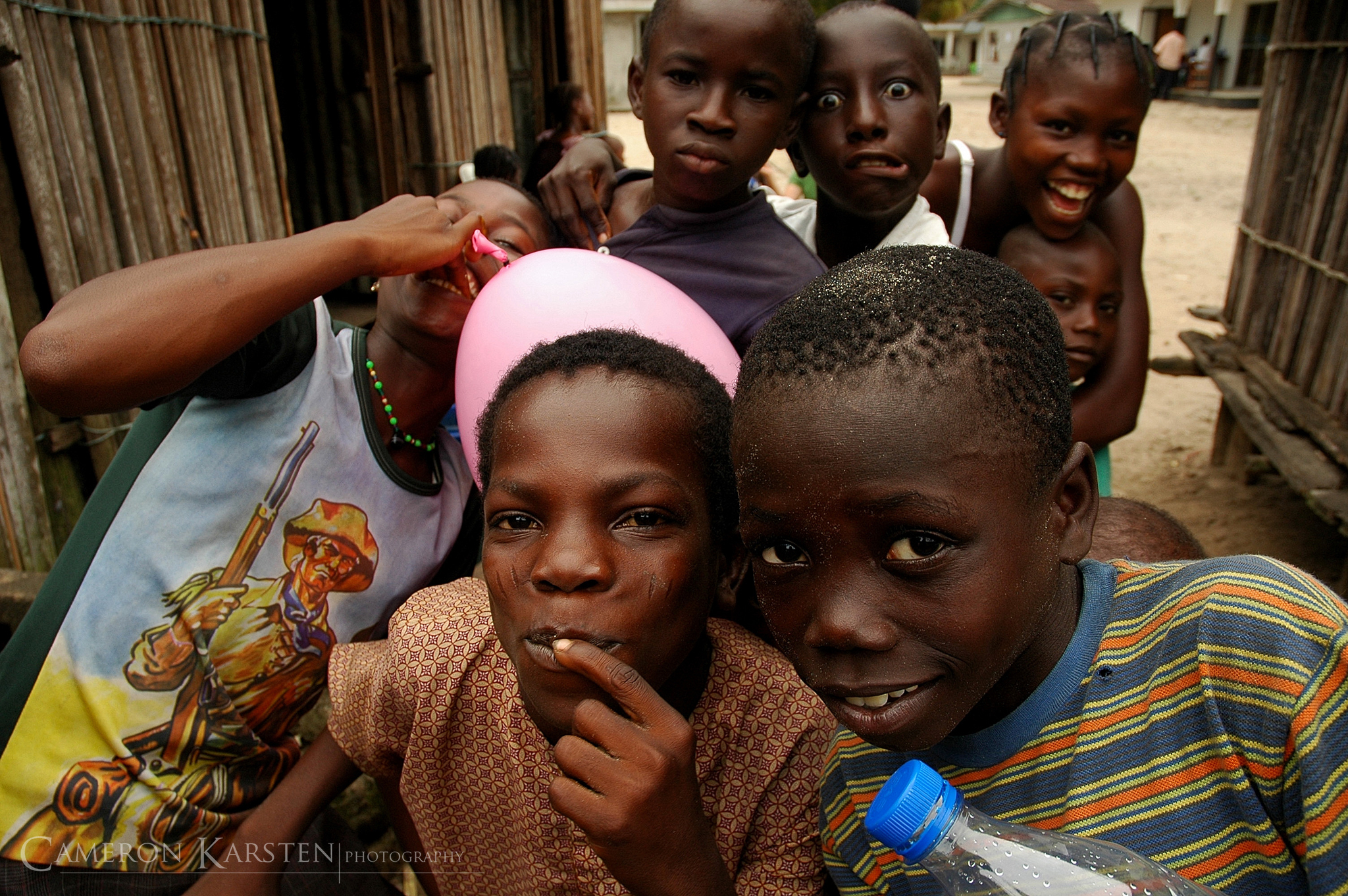
Vodou Footprints: Legends and Lore on Lac Nakoue

Day3_Ganvie-175

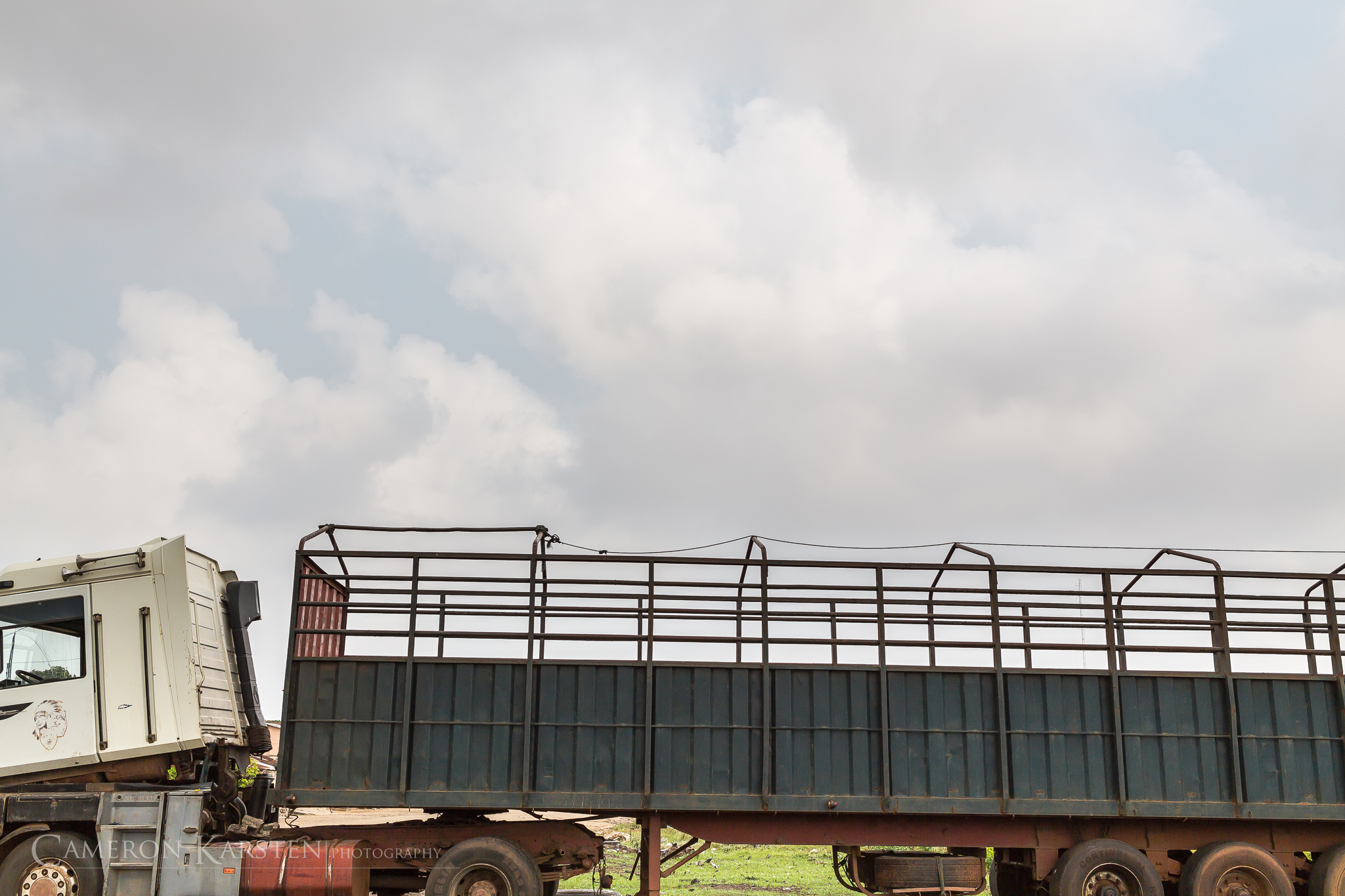
We speed north on a stretch of highway made just for the zemidjan, the motorbike of Benin that far outnumbers any other form of transportation in Cotonou. (For comparison, I’ve yet to see a single bicyclist.) In the local Fon language, the word means “take me quickly,” and they are not exaggerating. My driver weaves past other zems with mere inches to spare—honking, leaning, and accelerating in a mad death-defying ballet. It’s a test of stomach and sanity that I’ve never experienced. Plus, it’s early. We’re on our way to Ganvie, twenty minutes out of Cotonou. We leave the choked city with all its grinding muscle and hopeless might to enter a land of lizards, chickens, and goats—where you’re just as likely to see a Chinese migrant worker as a magical animal. And yes, there are plenty of both.

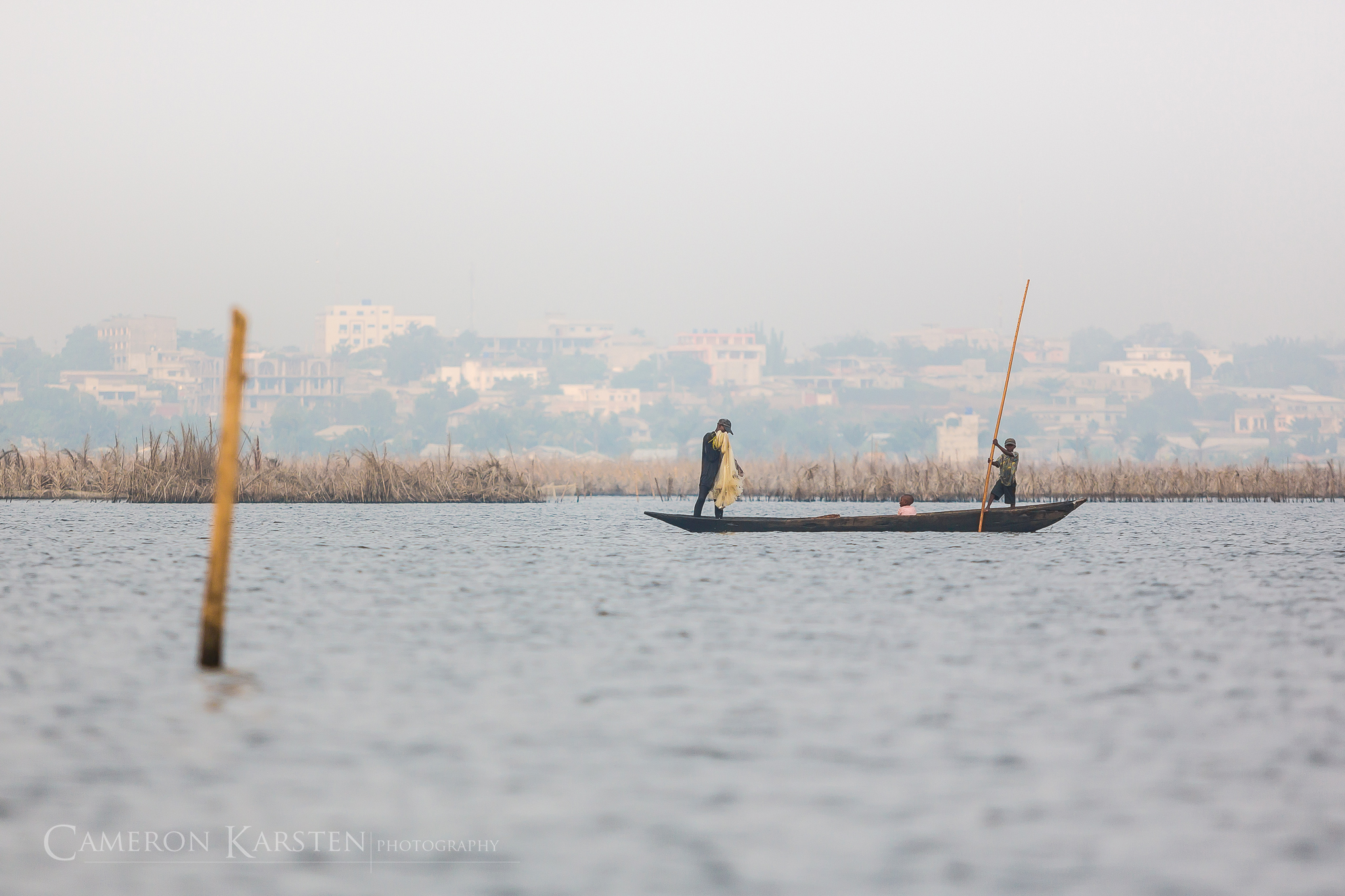
Ganvie is special, or so they like to recount. It’s a stilt village, built on things of legend. Known as the Venice of Africa, it is everything but. With wooden poles in place of granite columns, thatched walls instead of marbled halls, and corrugated steel roofs in lieu of frescoed cupolas, the village looks much like the rest of the African countryside—except that every structure floats above water. Fortunately, while the city’s foundation is only mildly intriguing, the history behind it is truly fascinating.

Day3_Ganvie-209

Benin, as both the willful cradle of the world’s most magical religion and the bound epicenter of one of mankind’s darkest hours, is a land like no other. Its past overruns with incredible lore, otherworldly powers, and inexplicable possibility. And Ganvie, that fabled stilt village, is a microcosm of this concentrated complexity.

At the height of the slave trade, the Kingdom of Dahomey reigned over present-day Benin with fearless authority. Opposition was swiftly dispatched, often through shackles and a sentence south into slavery. The Kingdom walls in Abomey are purportedly constructed of human blood, and the King’s throne built on the skulls of his Yoruba enemies. Of course, this ruthlessness was not without reward. In exchange for the capture and sale of slaves, Dahomey received weapons of warfare. To the Portuguese, a healthy grown man was worth twenty-one cannon balls; a woman or child, fifteen. Various rifles, jewels, and other luxuries were similarly bartered for the slaves that passed through the port village of Ouidah—more than 20,000 per year during its height in the 19th century. But for every ironfisted oppressor, there is a legendary resistor.

In 1717, the King of the Tofinu, a magical gent by the name of Abodohoue, felt the Amazonian warriors of Dahomey breathing hotly down his neck. Sensing imminent danger, he transformed himself into an egret and flew south from modern-day Allada over Lac Nakoue in search of a new homestead. What he knew was vital: the people of Dahomey had taken a religious oath promising that all humanly capture was acceptable unless it required passing over water. King Abodohoue kept this in his little egret brain and soon discovered an atoll of mud islands in the middle of Lac Nakoue.
Day3_Ganvie-97

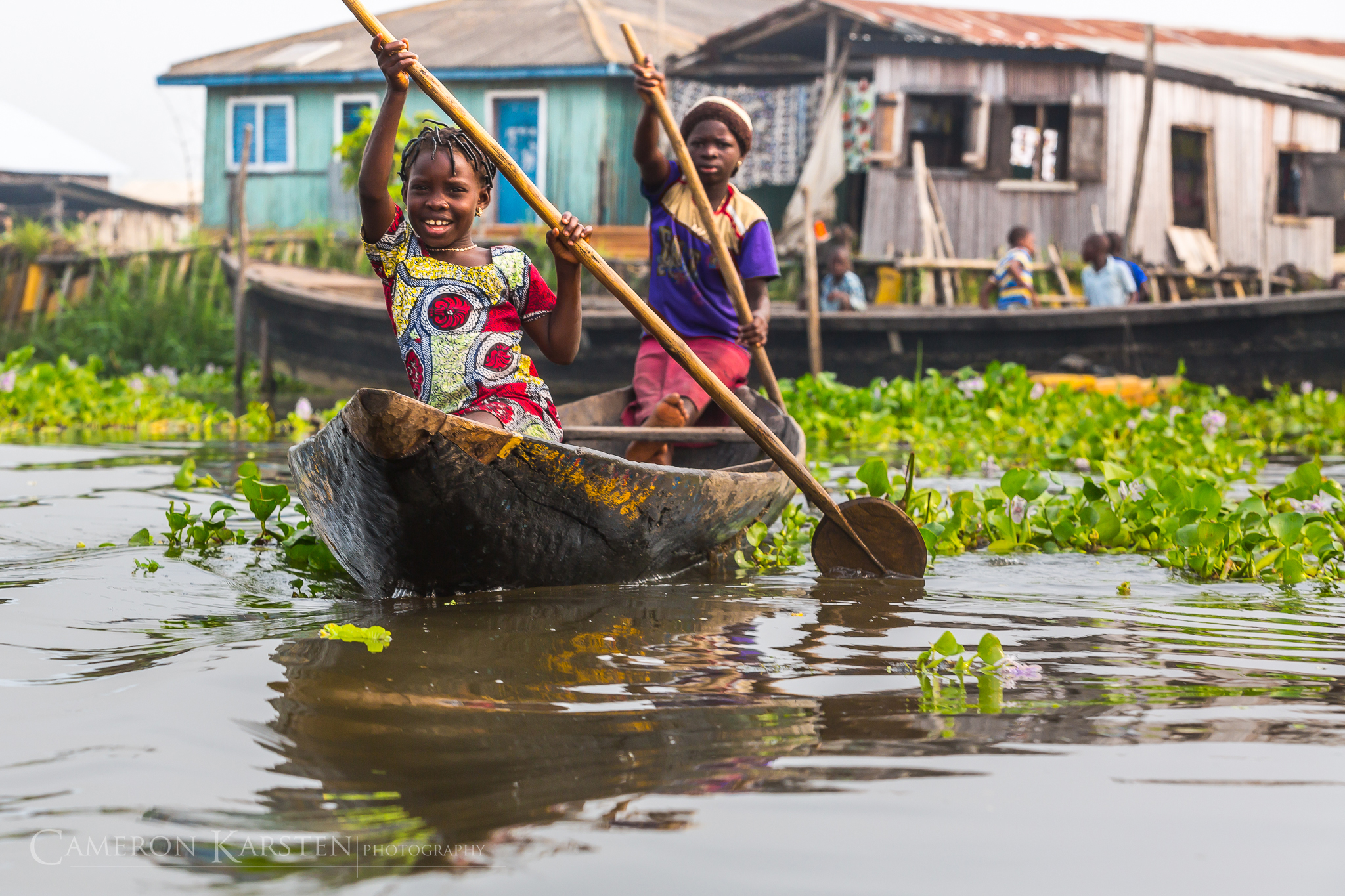
Next, the question of transport crossed the bird-king’s mind: How would he safely ferry his people to the islands? Well, like any capable land-of-Vodou king, he simply morphed from egret to crocodile, swam over to the local bask of reptilians, and requested their assistance. The crocs heartily agreed, and King Abodohoue’s plan was set into motion. With local lumber and the backs of numerous newfound friends, the Tofinu people transformed the center of Lac Nakoue into the Venice of Africa, a suspended village that today boasts of nearly 30,000 residents (and is Benin’s number one tourist attraction).

Day3_Ganvie-159

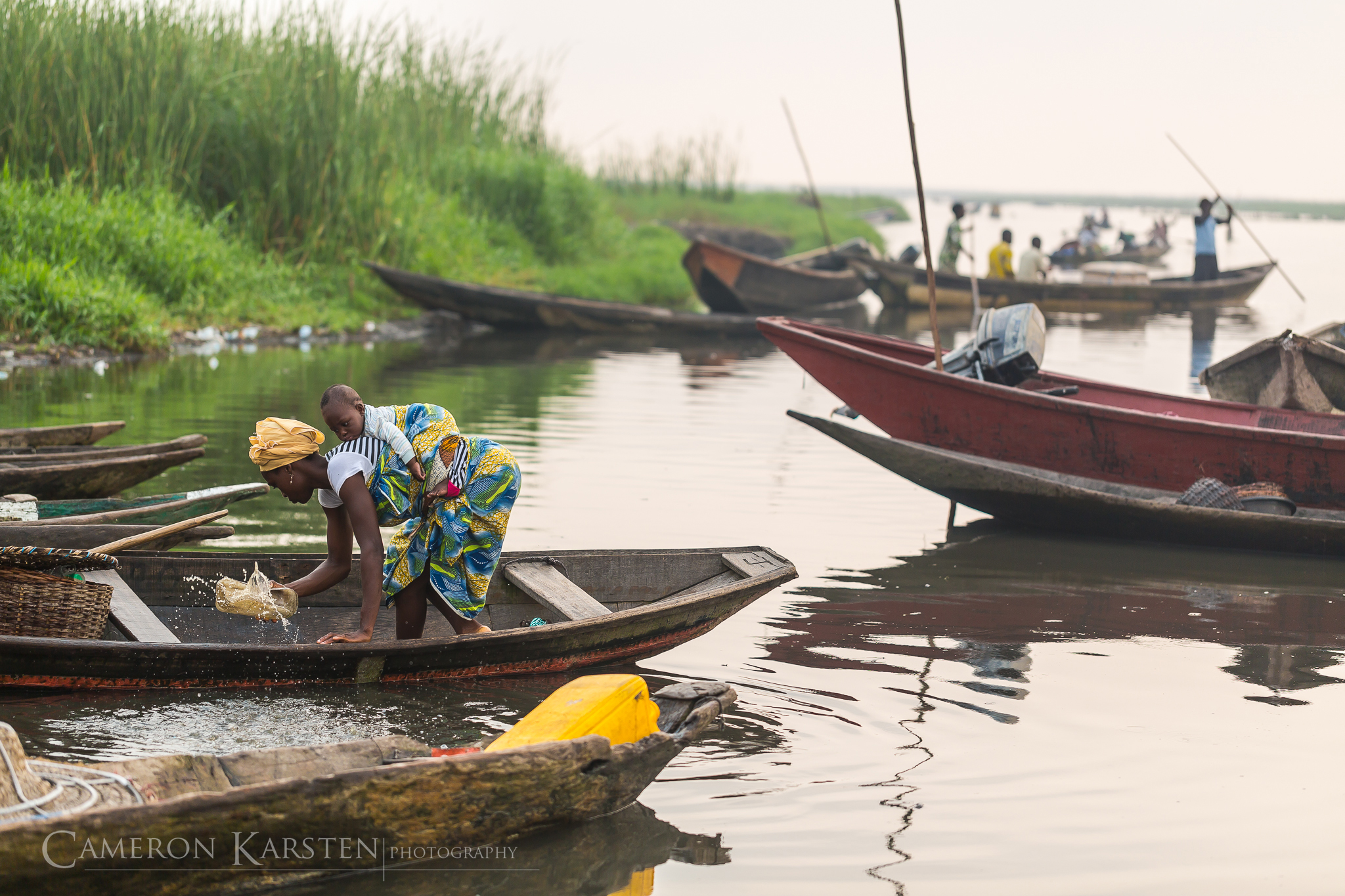
We’re here to see it firsthand. Joined by Stephano, our guide, we jump aboard a hefty, water-soaked outboard canoe to the marooned village. Despite our eagerness, we don’t spot any descendants of the loyal crocodiles. (Later, we learn that their population has dwindled to a paltry few—a case of the tale outlasting the tail.) Passageways are filled with pirogues and paddlers, reeds and water lilies. Life is simple. Sustained by fish farming, traded goods, and the slowly rising costs of tourism, the people manage a relatively normal lifestyle, in contrast to the environs. We come. We go. In truth, the town doesn’t live up to its past.

Along the nearby shores of Lac Nakoue, however, sits a much more intriguing town. Rich with Vodou and layered with countless stories (many of which we’re hoping aren’t true), Abomey-Calavi has long been a must-visit stop following Vodou Footprints.

Day3_Ganvie-4

Except for a handful of curious anthropologists and open-minded theologians, the Western world places Vodou somewhere between pseudo-religion and marketable nightmare. It’s a doll probed with pins and needles. The musty pages of a leather-bound spell book. A dark evil force. Something to openly scoff at, but secretly question. More importantly, it’s equated with fear.

For this (as with copious other misconceptions), we can thank the silver screen. Beginning in the 1930’s, Hollywood started crafting a crude and compelling mixture of back-alley-New-Orleans Hoodoo with plantation-Haitian Voodoo. Replete with unlikely plots and zombie-inducing potions, these films convinced the terrified, uninitiated masses (outside of Vodou itself) that this was the actual religion—emphasis on the fear.

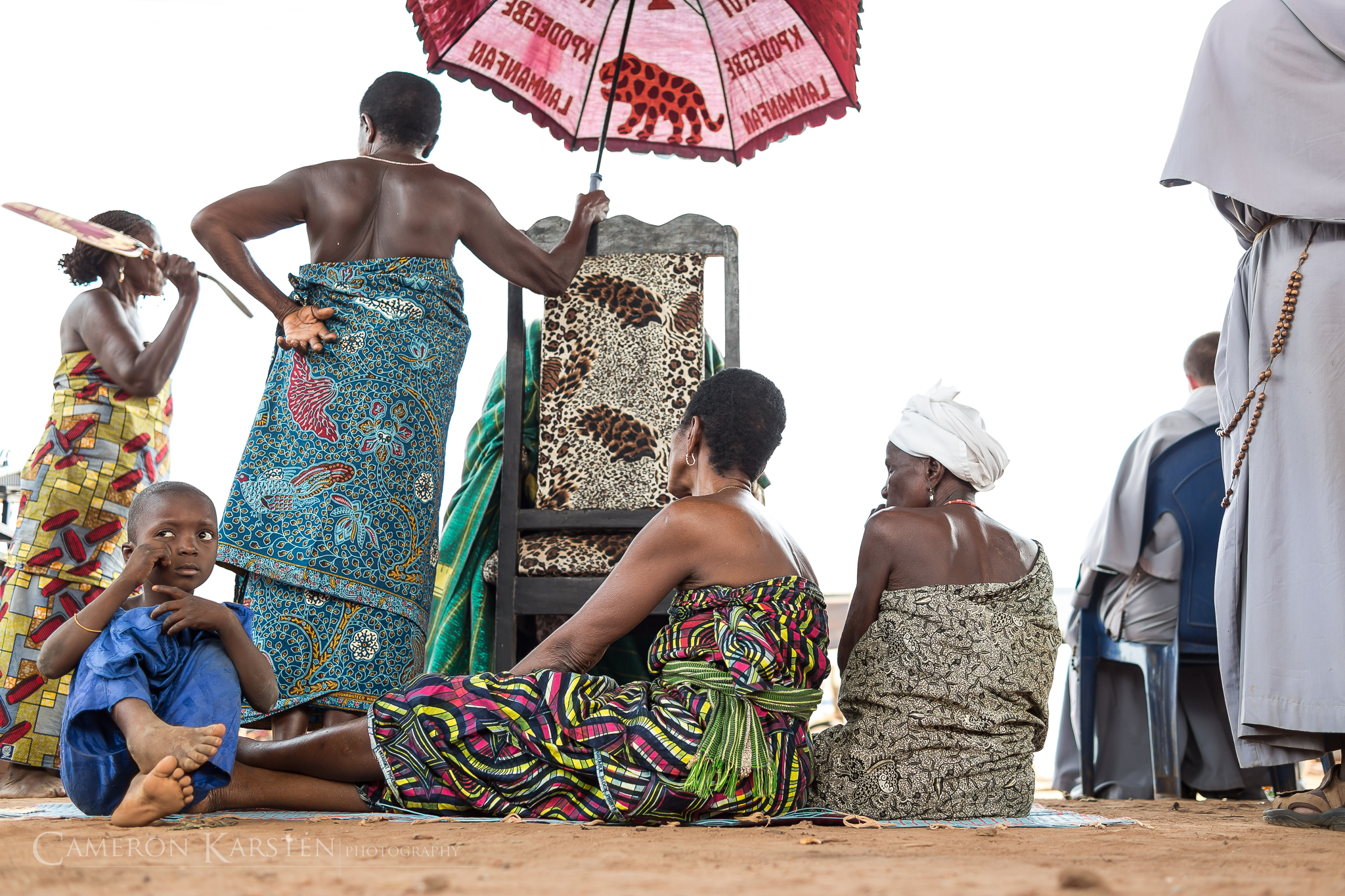
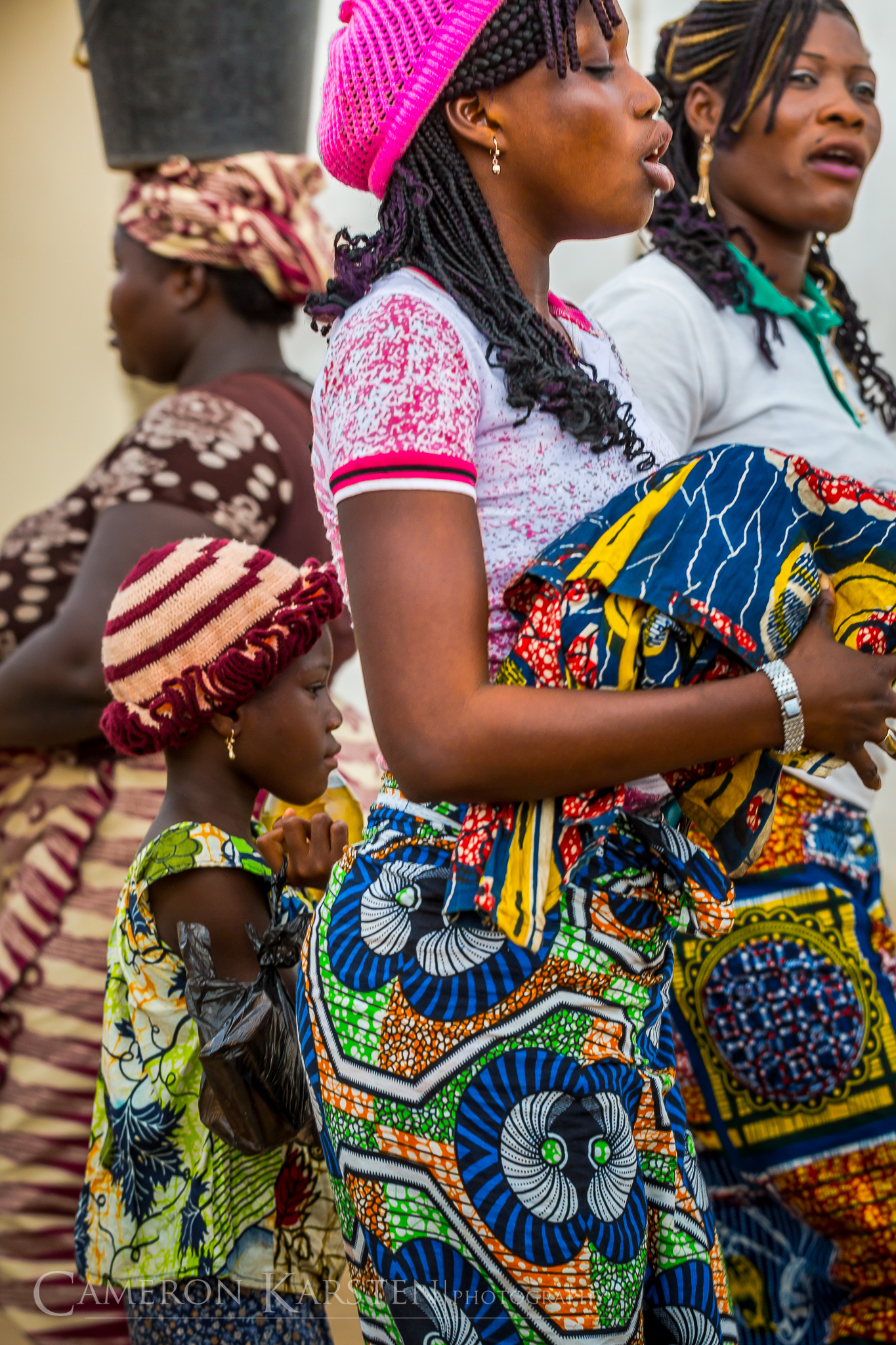
Vodou is, of course, less than these depictions would suggest, but in many ways more enriching and exciting. And crucially, Vodou is not to be feared—just as the police are not to be dreaded unless committing a crime. Some call it justice, others karma. In its stead, respect and prudence are superior traits. For the long-deceived Westerner, however, leaving the fear out of Vodou is easier said than done—especially in Abomey-Calavi, a town known for the unknown. After arriving on the shores of Lac Nakoue, we quickly disappear into its narrow passages. We’ve arranged a meeting with the king.
Day3_Ganvie-387

We aren’t quite trembling, but conversation has crawled to a tense halt. We enter a doorway, where we’re instructed to remove our shoes, socks, and shirt. Silently, we do as we’re told. Already, I feel like a child awaiting sentence outside the principal’s office. With our heads slightly bowed, we step inside the dark room.

We’ve heard stories of contamination; read about incurable and miserable plagues. I remember one tale and instinctively I scratch my forearm. Fleas. Everything we’ve read refers to fleas. The King of Abomey-Calavi is apparently infested with them. Carpets in the royal chamber are reportedly saturated with the miniature black parasites—a blood-sucking legion stealthily waiting beneath the shag for the white flesh of a foreigner. As I begin imagining my skin as the feast’s main course, I notice my partner with preparatory scratching of his own. I can’t help but picture our future together—collars tight around our necks, huddled on the floor of some quarantined windowless research lab.

We take a few more cautious steps.
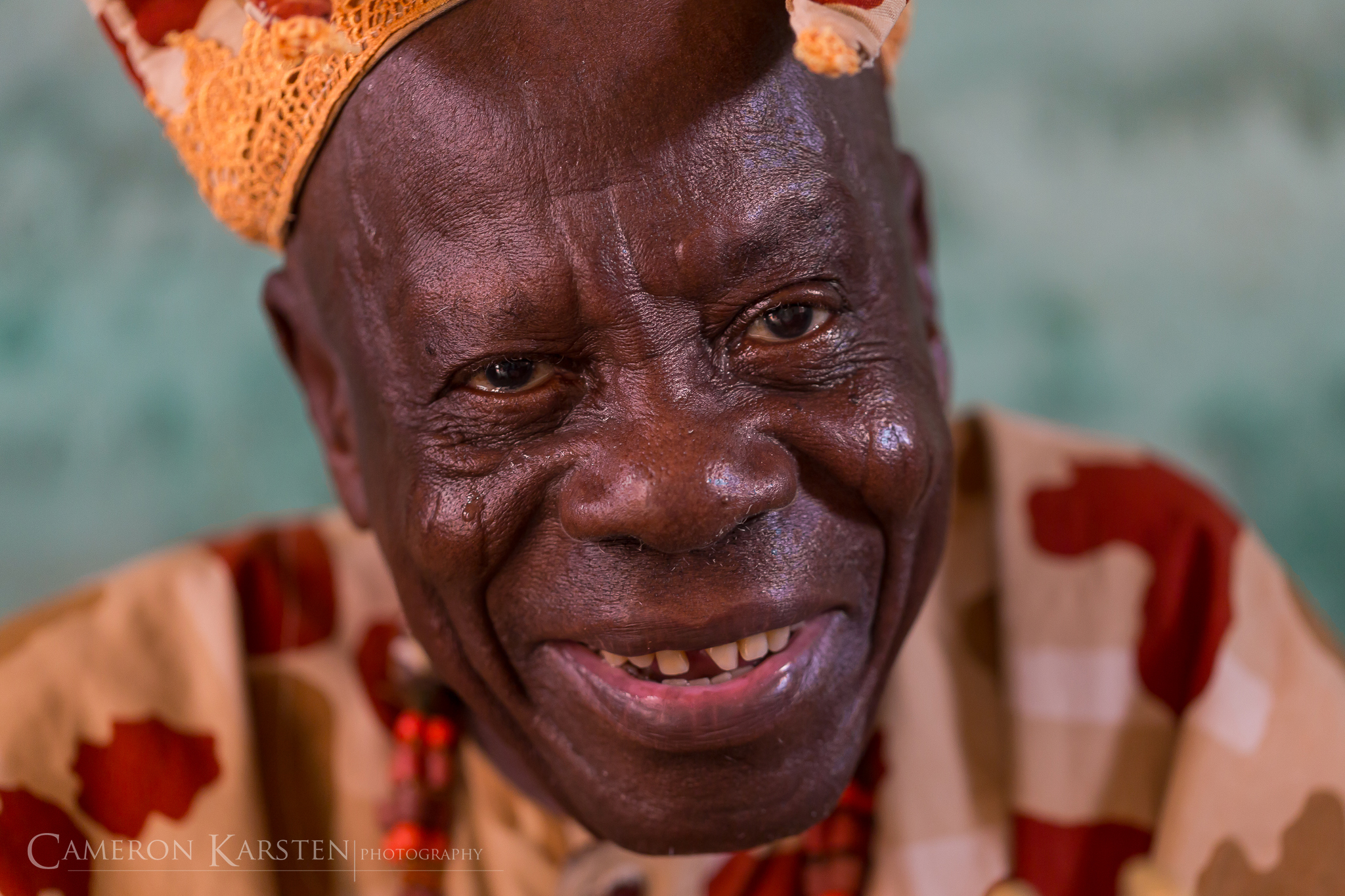
Day4_AbomeyCalavi-82

Any one of those rumored tragedies would put an instant end to our journey, if not more. We’ve neither time nor funds for borax soaks or chemical treatments. But we’re here, and we’re ready to accept the risks. If you want access beyond the books and into the unknown, you don’t have a choice.

As my eyes adjust to the dimly-lit room, I see no carpet. No fabrics of any kind—only woven mats and further, a gently waving waxy palm. Slowly, I begin to make out a large seated form. I take a final deep breath, and the fleas fly from my mind. We are face-to-face with our first Vodou king.

Next essay –>

logo_blackTrajan

Vodou Footprints: Egunguns and Other Souls of the Dead

Day2_Cotonou_Egungun-122

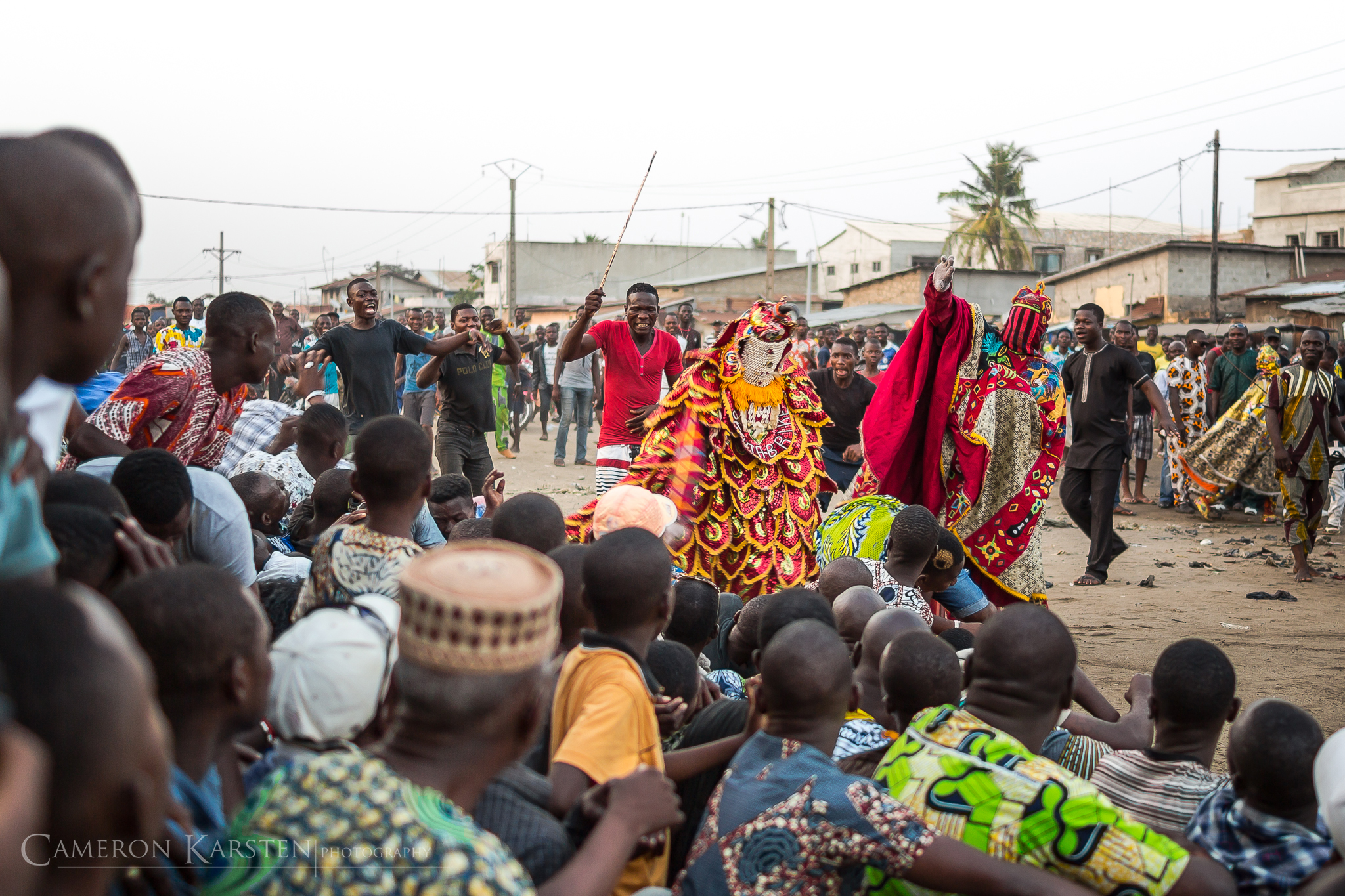
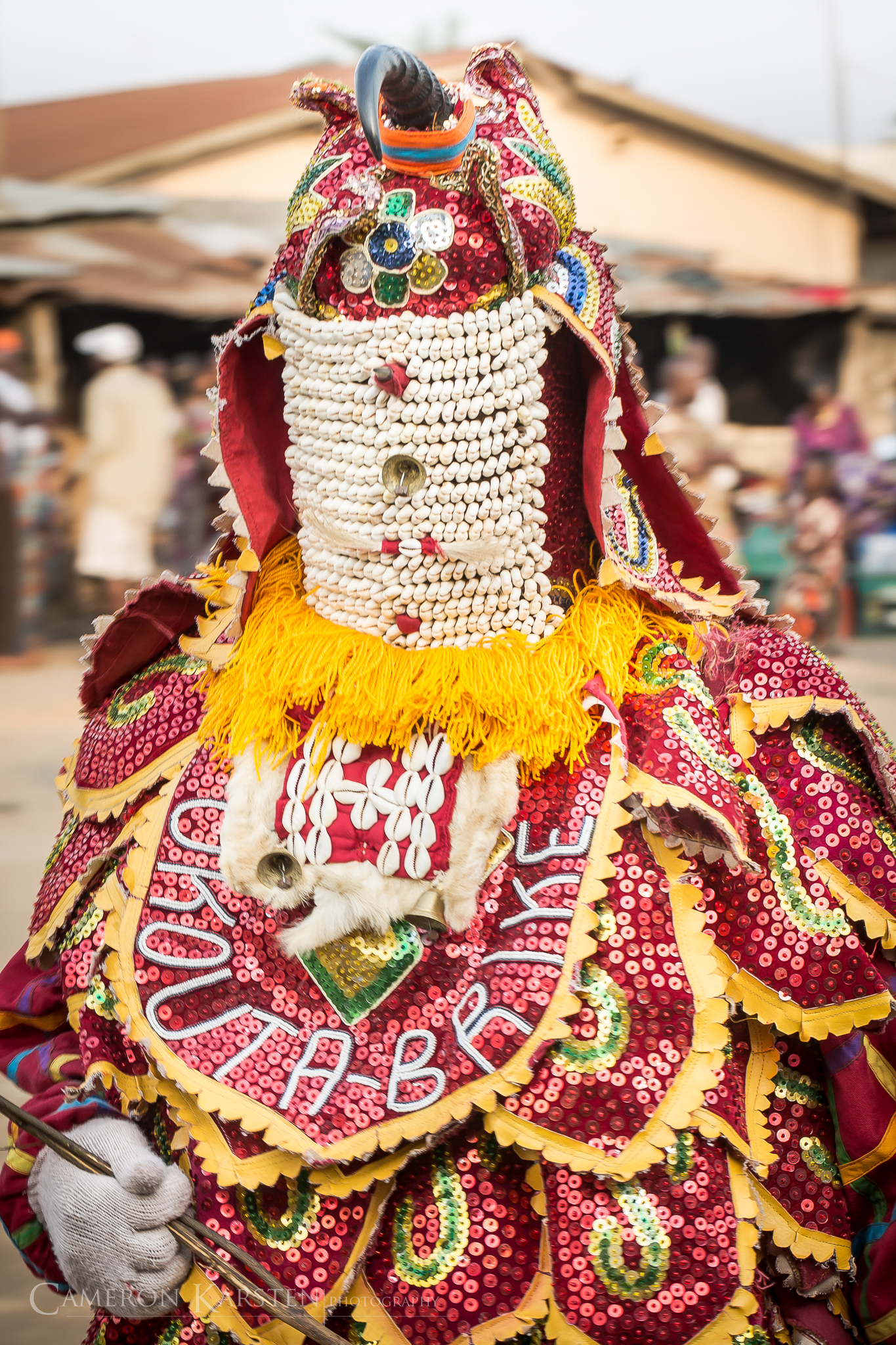
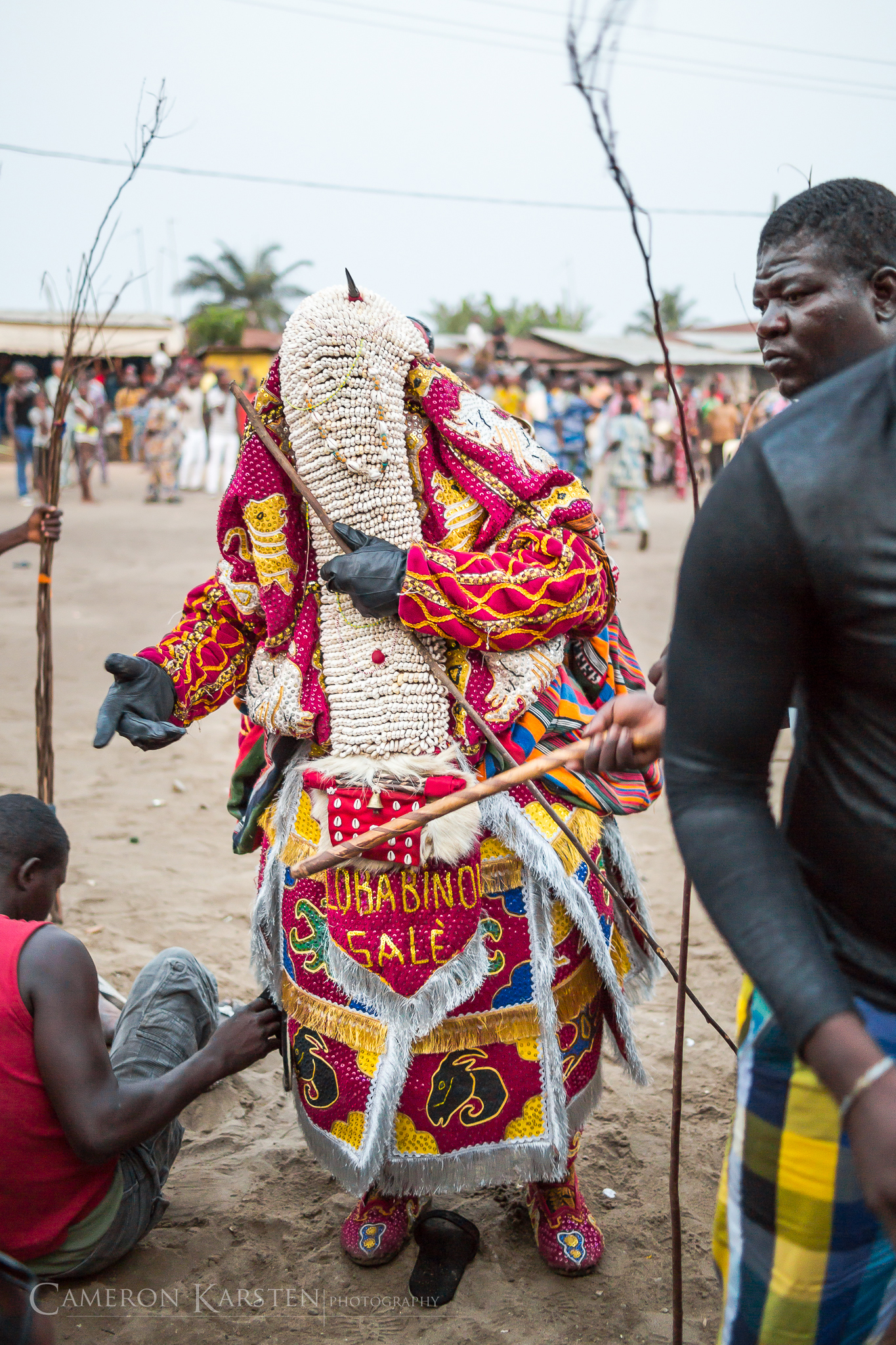
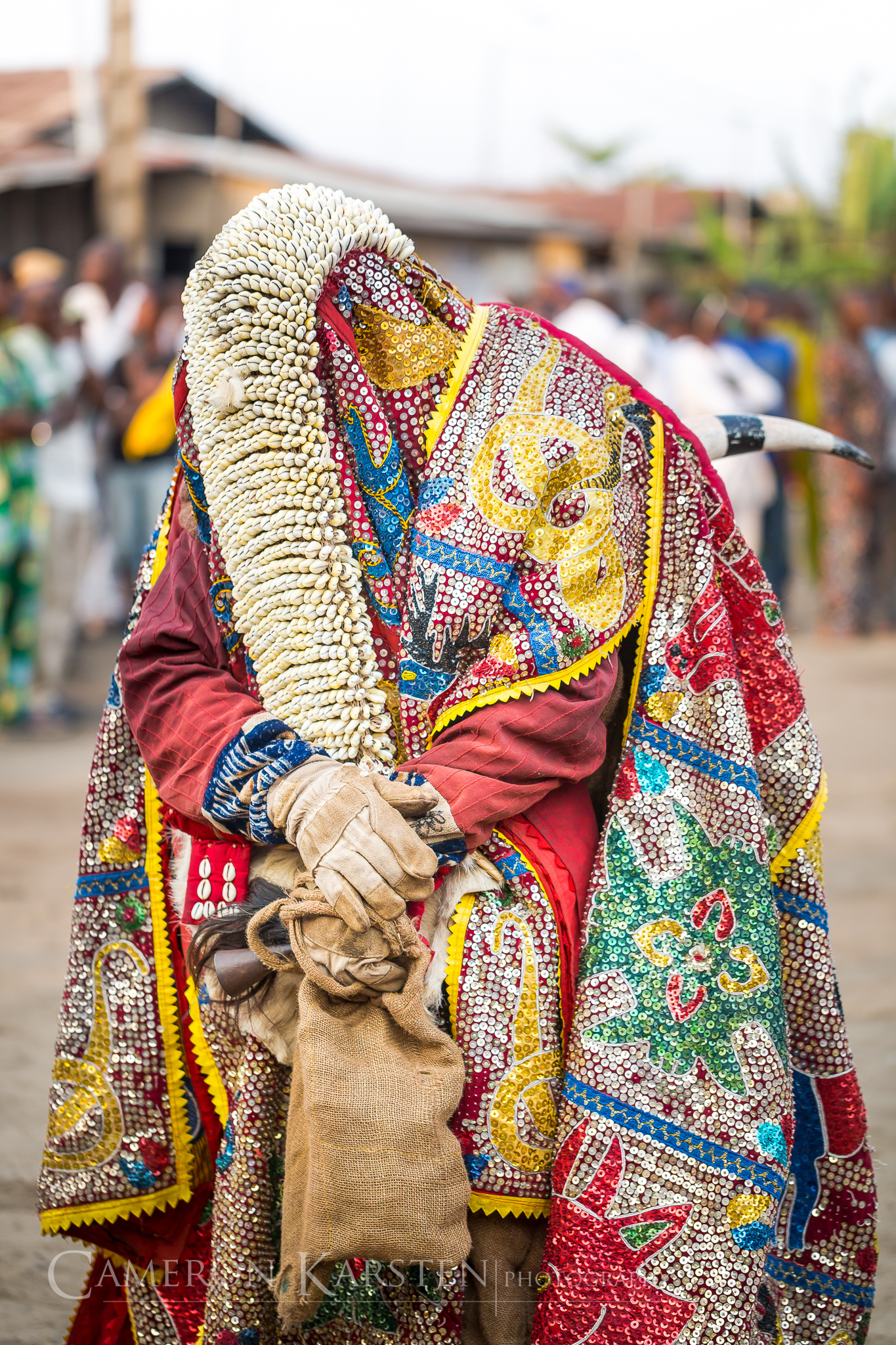
It is staring directly at me—there’s no doubt now. Looming up like a mythical beast, the spirit with bright blazing eyes has targeted me. Sequins, from mighty crown to lowly street, adorn the form in a glittering mist. Folds of thick fabric obscure the possessed body inside. Cowrie strands dangle and clash in the breathless fervor. Its movements are creased, unpredictable, and otherworldly. Transfixed, I turn to the face—yearning for the reassurance of something distinctly human. But no detail has been spared. Beneath the thin chainmail mask, all I can discern is the eerie soft suggestion of features as if pressed into a bedsheet—the phantasmagoric picture of death presiding over me. Now, I’m cowering.
A finger suddenly points in my direction. I raise a calming hand in supplication and instinctively squat lower. As the figure nears, I begin to hide my camera further below. My partner is but a few feet away and still squinting into his viewfinder. There is a brief moment of stillness. Then chachachachacha! His camera fires a fusillade of high-speed clicks.

Day2_Cotonou_Egungun-300

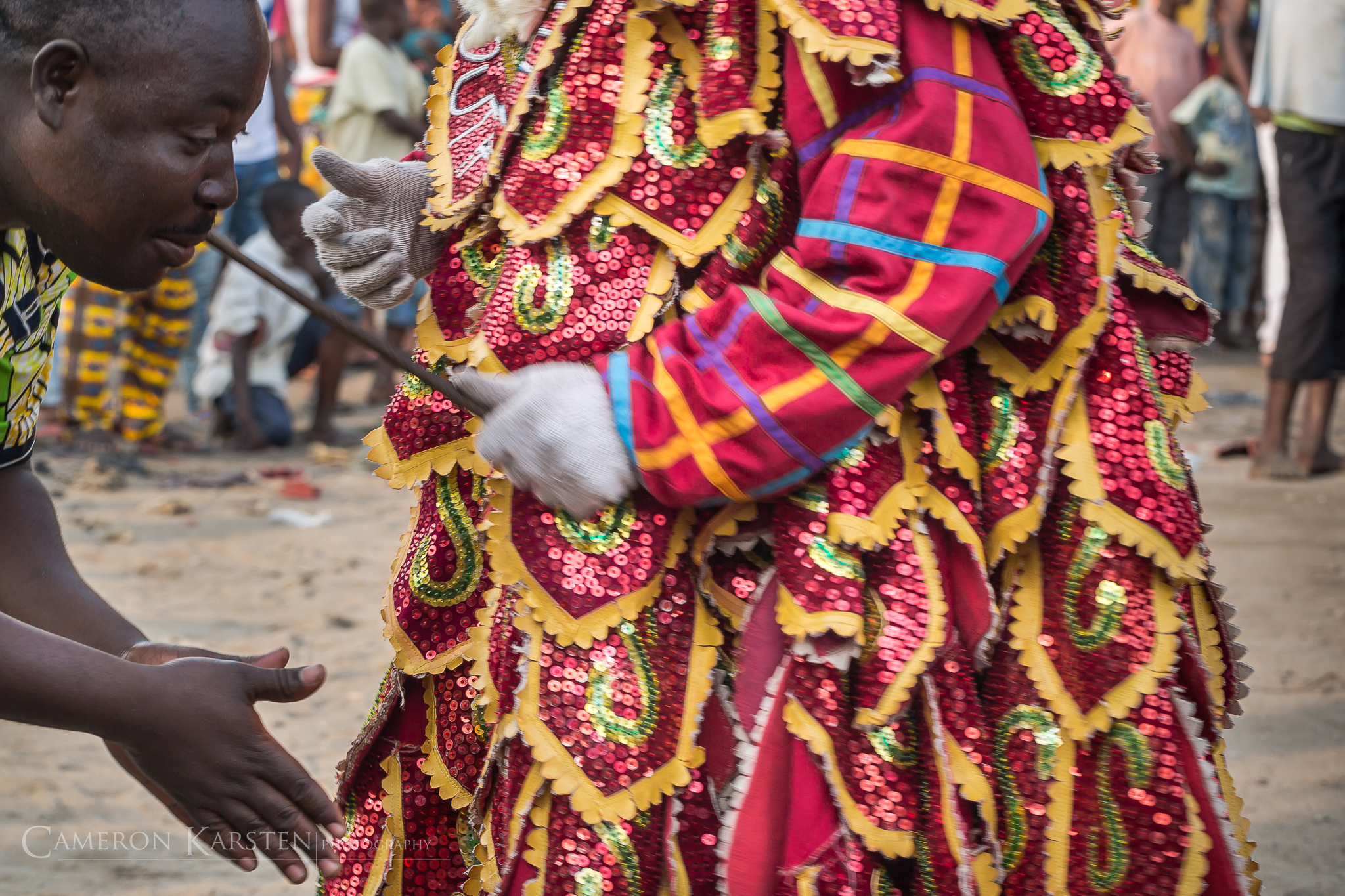
The spirit turns sharply and reveals a rising whip. The black crowd surrounding us joins in an uproar as the Egun slowly approaches my companion.

The whip is a tattered five-foot branch, split at its end into numerous lengths, which multiply and expand its powerful lashing. There are eight such instruments around the dirt field, each wielded by its own menacing spirit. Anyone foolish or daring enough to cross the area receives a brutal flogging—ceased only through rescue by the spirits’ guardians or that other time-honored savior, money.

Day2_Cotonou_Egungun-318

Lavishly costumed, variously colored, and elaborately festooned, these ominous dancers are the Egunguns. With garlands of yellow and orange, sequined waves of blue and green, and cloths of blood red, they are at once absurdly threatening and enchantingly beautiful. Atop each figure of dark elegance is a hat fit for a queen. Regal and lethal. The one bearing down on my partner also has a shield of horns on its back. And with each stride it twists and turns like a knife into flesh. Mortals cry beneath the might of the Egungun.

We’ve been accepted into this ceremony by luck (and a little loot), buying our way into the Yoruba ritual via our guide Stephano. In a backroad ghetto of Cotonou, we’re the only white people in a sea of a thousand celebrating Beninese. Men carry large cans of Guinness and Efes, while all are dressed in their Sunday best. With our pragmatic clothing and shiny camera gear, we admittedly stick out. Each time we raise a lens to shoot, even more attention is drawn by shouts from nearby spectators—and evidently, the spirits don’t need an excuse to investigate.

Day2_Cotonou_Egungun-178

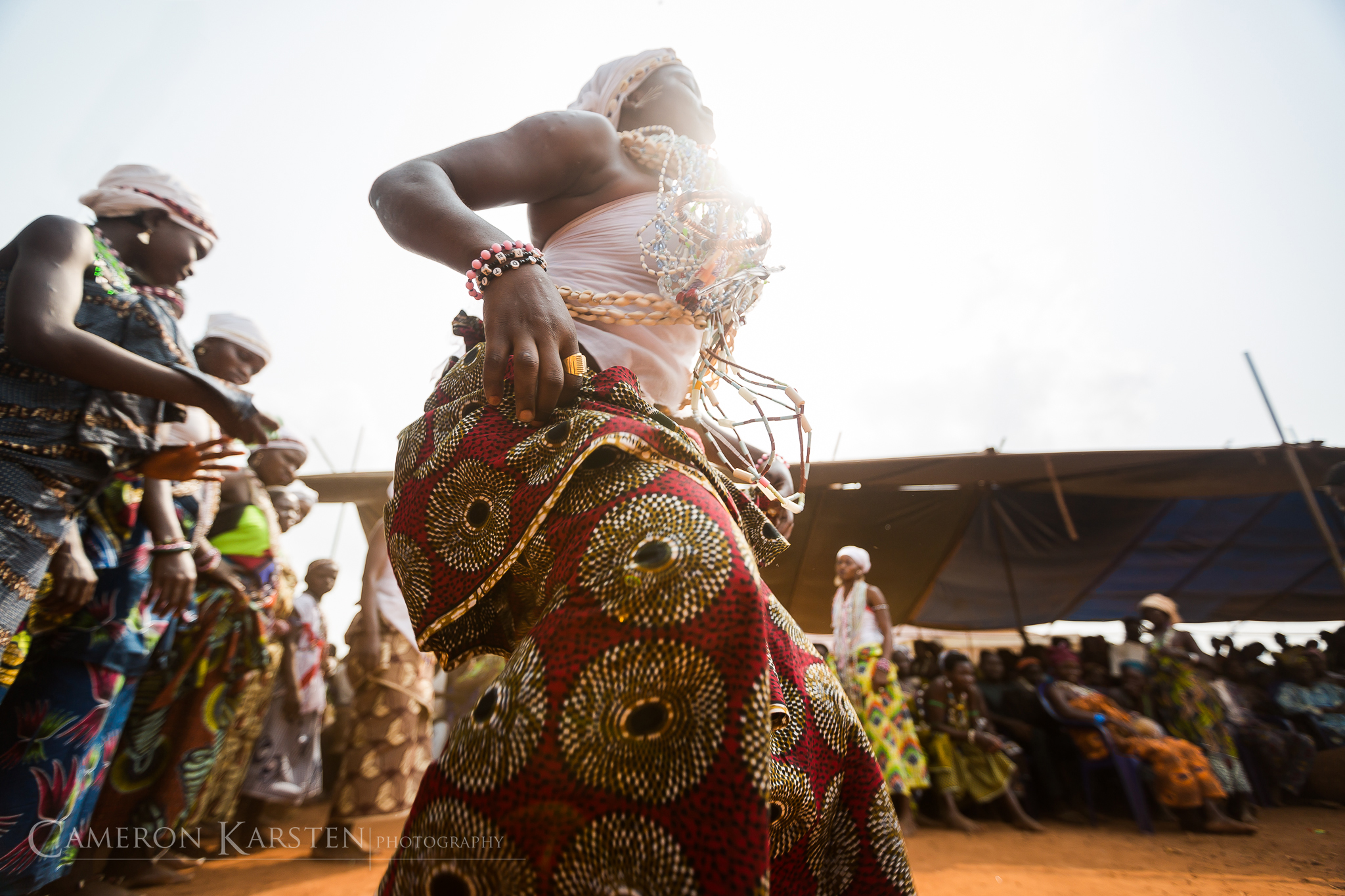
Egungun, literally “powers concealed,” are the souls of the dead—departed ancestors who have returned with advice to the living. Oddly, there appears to be more punishment than advice during this particular ceremony; but despite the imminent peril, it’s impossible not to feel something deep and ancestral about the whole spectacle. As these lively ghosts skate across the dust, they jump and stomp to the rhythm of the pulsating drums. The movement is infectious. With fluctuating spines and flailing arms, they fly as parrots in a trance.

And, in fact, the Egunguns are in a trance. Like all of Vodou, the Egungun society is a secret organization where only initiates are allowed access to the understanding, appreciation, and practice of opening one’s soul to trance state. Under the spell of music and sodabi (local palm alcohol), the Egungun spirit enters the body and becomes a direct translation of God. The Egungun’s words are final. Community members must obey; otherwise, their houses will be shaken. This obeisance is an essential tenant of any divinity in the ancient practice of Vodou.

Day2_Cotonou_Egungun-372

And right now, with the spirit upon us, obeisance sounds perfect. We can hear its breath. The whip is raised and threatens unmistakably. I keep my camera low. Hastily, our guide throws a wad of cash at the Egun. A guardian reaches down and examines it. The spirit, with a final glare, accepts and moves on. Others are not so fortunate, but the only two yovos, or whiteys, are spared today.

***

This was one of our first direct Vodou experiences—with many to follow. The energy was electric. The celebrations were riveting. The whole event seemed a fulfillment of spiritual rawness that transcended ordinary comprehension. Vodou is undoubtedly the inexplicable—and when we returned back to our room that night, we quickly rediscovered why.

Day2_Cotonou_Egungun-212

During the negotiations to attend the Egungun ceremony, we were told that if our offerings to the spirits were not accepted and we still remained to photograph, the mere presence of the Egungun within our lenses would completely halt our cameras’ systems. Memory cards would be wiped. Shutters locked. Only once departed would our equipment resume its normal operations. Fortunately, our offerings had been accepted.

That evening, however, something wasn’t quite right. While transferring our files—a task we’d each performed tens of thousands of times—we noticed that many were curiously missing. An entire flash card was corrupted. Substantial video footage from one of mine had also disappeared. There was no explanation. Our gear had worked flawlessly the whole time since arriving in Benin, including throughout the ceremony, and had never left our possessions. Bemused, but not convinced, we shook our heads and blamed the unbeliever’s trusted scapegoat, coincidence.

We set the room lock from the inside, as every night, and crawled off to sleep—the images of the day soon flashing and dancing beneath closed eyes. And as my mind began its graceful lengthening and gradual tumble into slow peaceful repose—I bolted up. Sunlight streamed in from the blinds. It was morning. Early. Then the door—the locked door—started to creak open, revealing the hallway’s dim florescent glare. Rising, I closed it. Reset the lock. And sneaking hesitantly back to sleep. I knew that coincidence had some serious explaining to do.

Day2_Cotonou_Egungun-90

On the following evening, I was again abruptly awoken, this time to two bewitching cries and a loud unnerving hiss. I had heard that wild cats occasionally roamed the guesthouse grounds, but these sounds came from an animal much larger and nearer. With my eyes alert in the pitch-black, I could just make out my partner upright in his own bed. Silence. Darkness. No more sounds were heard, but it was the feeling which followed that kept me wide awake—a feeling of otherworldliness and possession, as though in some other room, an inner spirit animal was haunting a fellow resident. I realized then that we were not alone in our endeavors. The Egungun had followed.

For the remainder of the trip along Vodou Footprints, similar oddities revealed themselves—occurrences that spun the uninitiated Western mind into perpetual circles of questioning and doubt. Everything that we had ever known suddenly became totteringly balanced on a precarious ledge of belief. A witchdoctor we would come to know and respect put it perfectly: “Human beings own the earth. But above the earth, there is only Vodou.”

After tales of human resurrection, piles of animal sacrifice, and bottles of snake venom wine, such simplicity resonates. Vodou is that onion whose inner ways are revealed only through time, discipline, and absolute respect. It will know when your purpose is false or uncertain—and if so, will shake your house to its feeble foundation. Remarkably, following Vodou Footprints, mine was only beginning to be built.

Next essay –>

Day2_Cotonou_Egungun-308

Day2_Cotonou_Egungun-588

Day2_Cotonou_Egungun-203

Day2_Cotonou_Egungun-100

logo_blackTrajan

Vodou Footprints: Cotonou’s Spark

Day2_Cotonou_Egungun-336

I’m four beers deep and still have the need for another. It’s only 90°F, but 85% humidity feels much hotter—as though my blood is simmering from the inside out. I’ve sweat all water from my body and therefore have settled for the coldest beer a man can find. Here it’s Castel, a favorite from Ethiopia. Although I know it’s not scientifically sensible, the heat has decreed my parched lips the ultimate authority. At one point, it looks as though the barman has run out. So when a case of chilled Les Beninoise is proudly unveiled, the relief amongst the patrons is palpable. I might just survive this after all.

Cotonou is an African mega-metropolis. This means it’s not fun. Streets are clogged with dirt, dust, and worst of all, a constant plume of suffocating exhaust. It is full of life, and yet its conditions seem to defy it. Nevertheless, with population estimates exceeding one million, the inhospitality of this land simply cannot match the resilience of its inhabitants.

Day5_Allada-42

Welcome to Benin’s unofficial capital and undeniable commercial force. It is a city of hustle and bustle—a city whose voice is a cacophony of screaming motors and exposed engines. Where bush-taxis appear and dissolve at each shifting gear. Monstrous lorry trucks creak from bent chassis and blare horns willy-nilly. And the omnipresent zemidjan (motorbike) blisters the road with fearless abandon. A mind will not rest in a city with such movement.

Of course, there is no way to avoid this city. One must fly into the airport of Cotonou Cadjehoun to land in Benin. This is how I arrived, after 37 hours of relatively painless travel. Upon arrival, however, my body instantly succumbed to the shock of the heat. A heavy sweat filled the creases of my back and brow. My nose filled with a miasma of burning trash and hot spice. I was disintegrating. At customs, the usual challenge of patience became nearly intolerable in this climate. Time above the desk registered 2AM. I was exhausted, and still there were cases to collect—not only those filled with more or less replaceable clothes, but also thousands of dollars’ worth of photography and video equipment. My mind wandered. I was helpless among the fray of fatigue.

Day2_Cotonou_Egungun-18

Incredibly, everything (including my arranged pickup) arrived incident-free, and I quickly secured the necessities of bed, air-con, and mosquito net. The next thirteen hours were nonexistent.

When I awoke, Constantine had arrived and was similarly in need of recovery. He slept. I slept more. Instinctively, we both knew that whatever lay before us demanded the utmost mental and physical preparation—no matter how unforeseeable and incomprehensible.

***

The Dantokpa Market is over twenty hectares in size and grosses over a million dollars a day. We met its alleyways with amazement—the endless stalls contrived of scraps of wood and stacked with every conceivable produce, electronic device, food, and knickknack. Baguettes abutted sunglasses. Plastics flanked pottery. Eerie fluorescent liquids from Passotome glowed in unlabeled water bottles. Fried fish charred under a searing sun-glare while flies swarmed in frenzy. And no matter what the ware, a smell that can be described only as uncomfortable pervaded. But these things only piqued minimal interest. We sought something more bizarre—something more truly sacred to the people of West Africa: the fetish.

Day2_Cotonou-16

We had met at the Eddie Adams Workshop in upstate New York a mere three months before. As we traded stories and aspirations of travel and photography, we quickly formed a strong connection—a common desire to capture beautiful images of cultures around the world. On the second day of the workshop, he had approached me with a simple enough question: “How ‘bout a project?”

“Well, yeah. I’m interested.” Unbeknownst to me, he was proposing a much larger collaboration than I understood at the time.

“How about Voodoo?” he asked.

My hesitation was barely noticeable. “Hell, yes,” I blurted. Just like that. Although I knew little about Voodoo (or perhaps because of that ignorance), I couldn’t turn down such an enticing opportunity. It hadn’t been a question; it had been a summoning.

Day4_AbomeyCalavi-161

Three months later, we saw our first glimpse of the fetish. At Marché Dantokpa, we came across a table laid with an assortment of dried animals and constituents: monkey heads, gator claws, mandibles, chameleons, snake skins, and numerous bone fragments. To our untrained eyes, most of it was practically unrecognizable; but we knew we’d hit the jackpot.

It was guarded by two young Beninese men who clearly wanted nothing to do with us. At first, they simply ignored our presence. Undeterred, we continued to ogle the various items with wonderment—all the while attempting that woeful balancing act of respectful distance and inquiring curiosity. A few moments later, it was obvious that we weren’t intimidated by their coldness, and so the guards began to shoo us away: “No tourists! C’est mal por vous!”

We had no choice but to leave, and leave we did—but not without first satisfying and redoubling our growing determinations to see and to know what exactly had sent us halfway around the world in the first place.

Day3_Ganvie-40

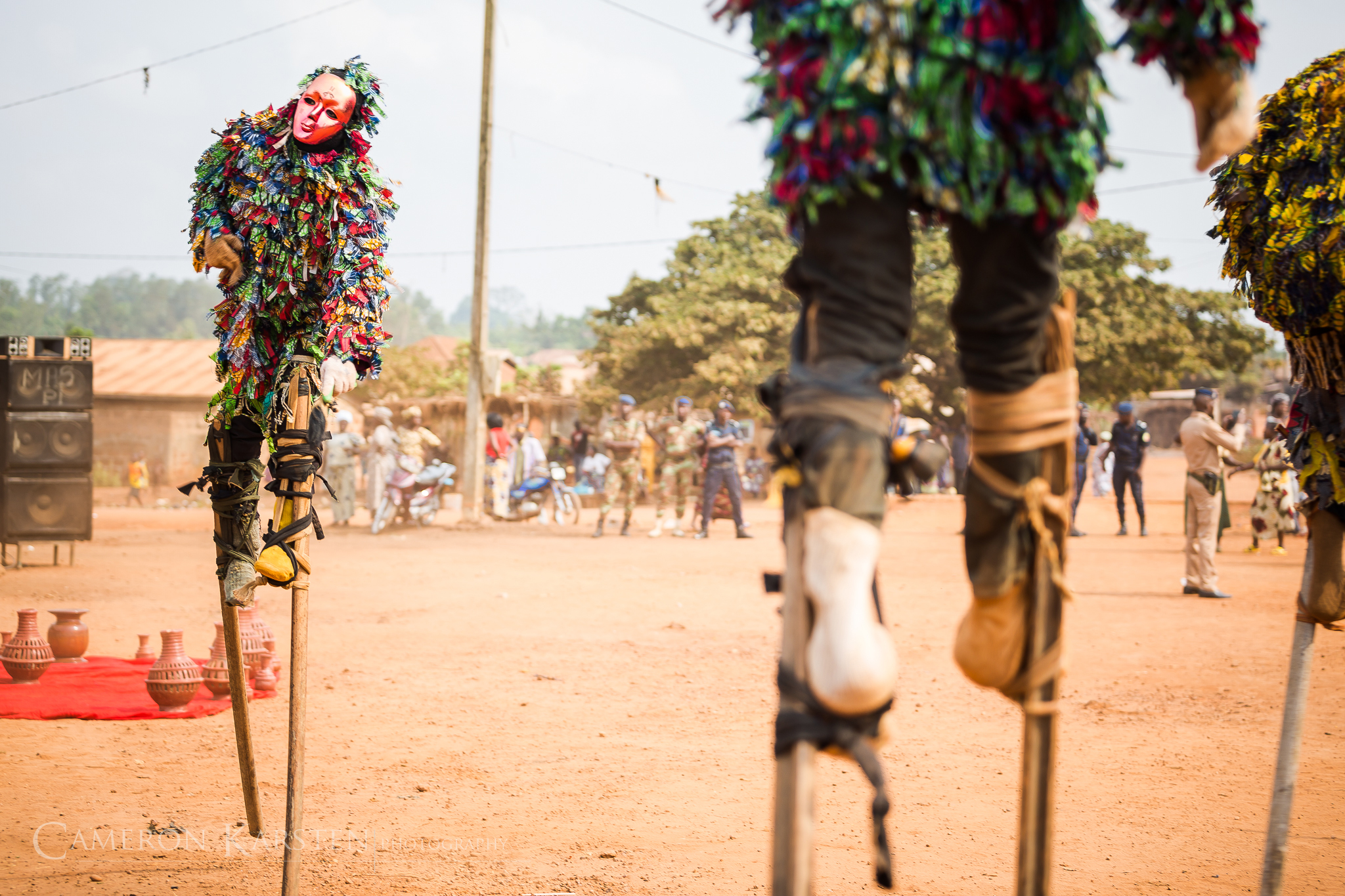
Even still, little could we have predicted that within hours of dismissal we’d suddenly find ourselves thrust headfirst into the ceremony of the Thron god, face-to-face with Egungun spirits, and openly accepted into the Vodou community. Ultimately, the fetish market of dried livers and crispy hyena hairs, fascinating as it was, would be but a rousing sip from the bountiful tonic of Benin.

We had caught the spark of Cotonou.

Next essay –>

Day5_Allada-204

Day3_Ganvie-238

Day6_AlladaVodou-84

Day2_Cotonou-141

logo_blackTrajan

Vodou Footprints: A Faraway Land in Benin’s Cradle of Vodou

Day6_AlladaVodou-452

Geography, for many Americans, is that daunting and embarrassing mystery—a dim knowledge largely confined to wartime allies, historical enemies, and the occasional topical hotspot. Beyond this so-called important handful—Western Europe, the Middle East, possibly China or Japan—everything else is clumped together into a world of unknowns.

When I told acquaintances of my impending trip, the average response was somewhere between hesitance and puzzlement. Like a jargoning doctor to the common patient, my words didn’t ring many bells.

Well, perhaps Benin is a faraway land.

Day3_Ganvie-356

Admittedly, I too couldn’t place Benin in its exact location prior. West Africa, I’d say evasively, somehow hopeful that several nations would willingly surrender their unique identities to their greater region. Technically, I wasn’t wrong. But not surprisingly, I soon discovered that Benin deserved far more respect and scrutiny than I had originally expected. Take a closer look and you’ll begin to unravel a majestic tangle of complexity and misconception.

Benin borders Nigeria’s western edge, touches Togo’s eastern boundary, and supports Niger and Burkina Faso above. It is one of those tiny West African countries that stretch north to south. Sneeze and you’ll miss it. In fact, picture Africa’s western shoreline as a nose. Benin sits just beyond where the mouth and the nose would meet—at the nostrils, if you will—a sliver of land anchored by the fabled Bight of Benin.

And then there’s magic. In the West, the word conjures up David Blaine, television’s greatest living magician. A levitating, fire-breathing, death-defying illusionist. A beloved celebrity of record-setting endurance. A talent, no doubt. From the Beninese perspective, however, he is not a man of magic. Call him master of deception. Magic in Benin is a way of life.

Day1_Ouidah-112

Everywhere there is magic. It’s in the red earth of the landscape, the throbbing fury of the sun, and the relentless currents of the great flowing rivers. It’s their religion—a religion in which the interactions between nature and humanity are cherished and respected every day. Magic is Vodou. And with 4,000 years of magic backing it up, Benin is the undisputed cradle of Vodou.

Personally, I believe in magic, both as a form of deception as well as a supernatural expression of the energies beyond ordinary comprehension. For millennia, Homo sapiens—the self-proclaimed wise man—has existed, evolved, and generally erred, all the while attempting to explain: What lies beneath? What forces create the churning seas of the ocean and the gyrating clouds of the sky? What energies course through veins and roots alike? Indeed, what does our cunning and craft amount to aside vast incomprehensibilities? Our attempts to solve breed yet further questions. No matter our advancements or industry, the sun still rises and the moon ever orbits to a language seemingly all their own.

Day5_Allada-173

Countless cultures have contrived to explain these fundamental phenomena. Some grow. Most fade beneath the all-consuming flames of war and oppression. And yet, incredibly, amidst the largest powerhouses of the world, there exists a small country—undeterred by the folly of others and sorely ravaged by the horrible histories of slavery—where the primeval practices still prevail and the honor of the mysteries of the world take precedence.

Cast aside the linear mindset and the textual teachings of the West. Simply observe what is before you and what has come to pass. Only then will you understand Benin. Here the supernatural and natural worlds converge; everyday occurrences take on special meanings; and the privileged traveler may join the setting sun into the obscurity of a secret and sacred society to appreciate the mysteries of what Benin declares its official religion: the worship of the Vodou.

Day6_AlladaVodou-366

It is a world of shadow and dance. Of masks, scars, and tattoos. A country where Kings remain the Kings of Kings, and the leopard and snake reign in the household tale. Feel the pulsing rhythm of Vodou, transcend the merely tangible, and let the beat of the drum lift your mind into the realm of the metaphysical. Once you have crossed this threshold, once you have heeded this singular call, the world around can never be the same.

For us, there is no retreat. There is only the universal language of Vodou, and together we will drink from this bottomless cup.

Together we’ll reach a faraway land.

Next essay –>

Day6_AlladaVodou-507

Day2_Cotonou_Egungun-236

Day6_AlladaVodou-173

Day2_Cotonou_Egungun-1

Day6_AlladaVodou-578

Day4_AbomeyCalavi-197

logo_blackTrajan

Vodou Footprints: Origins of Vodou (West Africa)

The Mono flows out into the sea on a bleak, wind and sand-blasted beach that is not very likely to entice you in for a swim…If your interest is in Voodoo then with luck (and some bravery) you might be able to persuade someone to paddle you over to one of the villages hidden on the backwaters where the Voodoo spirits are especially active…One village especially, Kpossou Gayou, would be fascinating to explore, but the chances of getting someone to take you are very remote because of the sheer power of the Voodoo here and the bad vibes surrounding it. It’s said that the fetish is so strong that almost anyone can hear it speaking quite openly and most of the boatmen in the area are much too frightened to take a foreigner there.

Butler, Stuart. “West of Cotonou.” In Benin: The Bradt Travel Guide. Chalfont St. Peter: Bradt Travel Guides, 2006.

Giving-Self---Version-2

These were the words that sealed my fate—that stirred an inexplicably ancient power and compelled my to explore. Something deep within was awoken. Something unfamiliar, incomprehensible, perhaps unknowable. While the boatmen supposedly trembled with fear at the mysterious forces, I tingled with desire. With each new mist-shrouded image or wind-savaged vision, a growing vortex drew me down towards the vague, inscrutable center. Determined not to flee, I embraced it unnervingly.

The more I read, the more I realized the sheer inevitability. Wants became needs, and more than curious, I was famished for answers and driven by pure adventure. There was no turning back.

Magic-Makers

But first, some backwater backstory: Vodou, established by short-term president Nicephoro Soglo, became the official religion of Benin on Jan. 10, 1996. Subsequently, this day became the National Day of Vodou, when the world’s largest Vodou festival occurs every year in the old slave port of Ouidah. And yes, I soon realized I was going.

A project plan emerged. Guesthouse. Driver. Guide. An itinerary with just enough structure, but purposefully rough to match the raw mystique of our journey. In total, 37 hours of travel, 37,000 feet above the earth, separated us from departure in Seattle to touchdown in Cotonou, the unofficial capital of this land called Benin. Across ocean, sea and desert, those fateful readings would finally come to life.

Of course, Vodou (or voodoo to our ears) is anything but the doll-and-pins novelty it’s often indifferently ascribed. Rather, it is an active mysticism that has weathered thousands of years on the continent of humanity’s birthplace. As such, in undertaking our own journey, we also endeavored to understand Vodou’s journey: from its cradle in West Africa, its reluctant passage across the unforgiving slave route, and its ultimate assimilation into the cultural and religious stew of the West—thousands of miles and meanings away from its native land. But I digress; it’s time to approach the destination ahead. Pluck up your courage. Open your eyes and ears to the spirits. And follow closely as we enter: Vodou Footprints – Origins of Vodou.

Next essay –>

Global-Educates

The heart of the Lower Omo Valley, Ethiopia

Spine-of-Lower-Omo

Hamar territory – Lower Omo Valley, Ethiopia 

The-Elephant-That-Could

An orphaned elephant being fed at the David Sheldrick Wildlife Trust – Nairobi, Kenya 

DSC_0092-(4)---Version-4

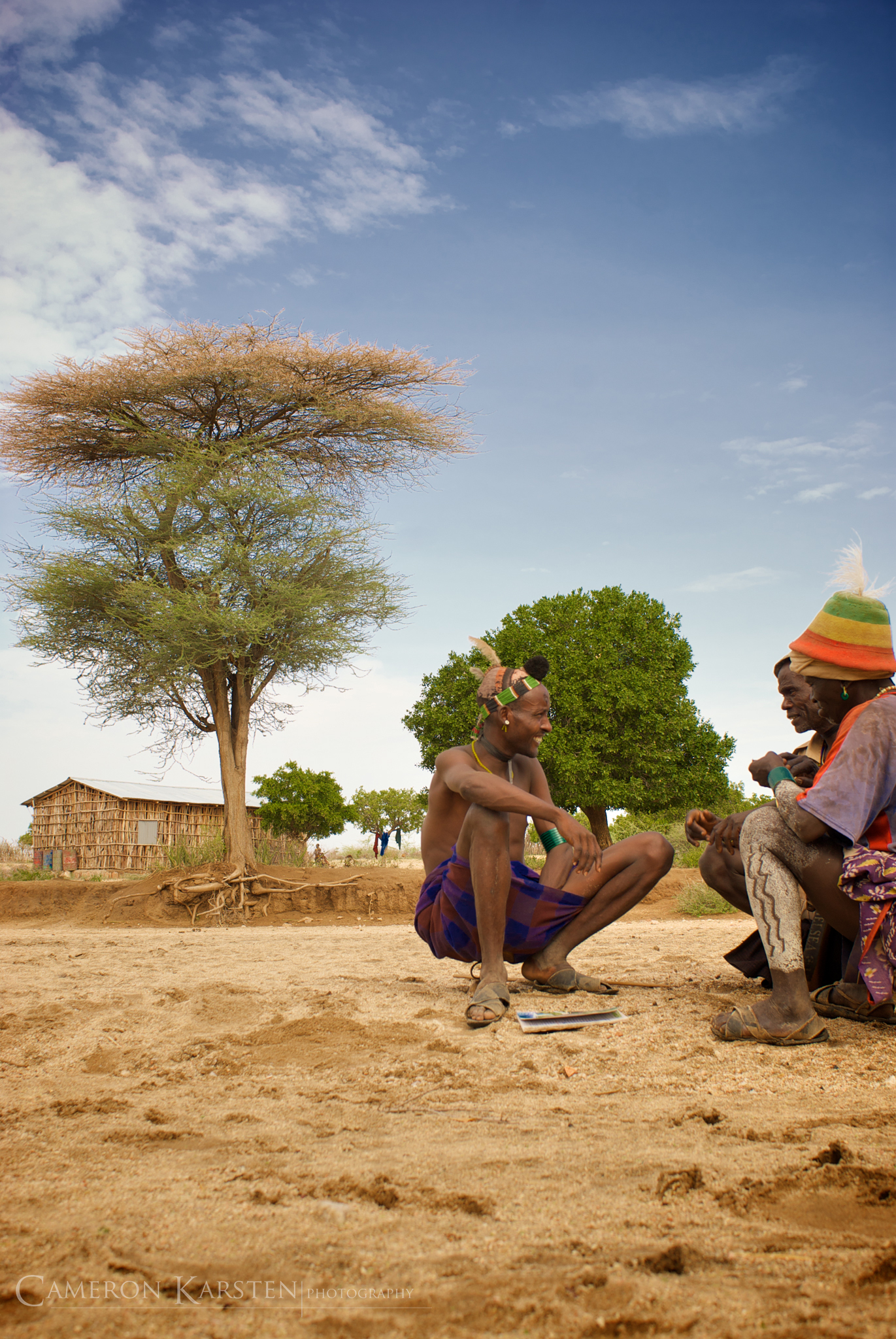
 A dry riverbed in the Lower Omo Valley. The government’s proposed dams have dried up the Hamar’s traditional water sources

Colee's-Retribution

In the riverbed – Lower Omo Valley, Ethiopia

Wild-West

The Wild West of Nigeria – Niger Delta, Nigeria

DSC_0085-(3)---Version-3

Jinka’s town square – Jinka, Ethiopia

logo_blackTrajan