This slideshow requires JavaScript.





The Kenyan Spectrum: The Good, The Bad & The Just Alright – Part III
April 7, 2010 by 9 Comments
Paradise Lost
A conceptual image of Paradise is reality, but can only be found within the architectural framework of an idealist’s imagination. Just like Happiness and Sadness, Good and Evil—these concepts do not exist, yet are everywhere. They are undiscoverable, can’t be found, hidden from the materialistic world; though they simply wait, readily available to be experienced whenever the heart is open and the mind broad.

In The Island of Lost Maps, author Miles Harvey states:
“These days… not even the truest of true believers would dare to put Paradise on a map. Yet despite the cynicism of our age, we humans have not lost our urge to quest after that place of perfect contentment, never quite finding it but never giving up hope, sometimes drawing so near that we can almost smell the faint sweet scent of its blossoms or spy the distant glimmer of its waters” (Harvey, pg. 234).
Our paradise began with a departure for Africa, leaving the ardors of daily living. The smells of inky bills. The sounds of scratchy cell phones in spotty reception. The cluttered schedules boggling a mind of needs and necessities. What a dream. Then, their complete disappearance as paradise blossomed, thrived, and then wavered in and out of reality as we experienced the traveler’s lifestyle. But the very concept continued to flourish. We moved through life. We felt the gift of the present moment, lost in distant lands and foreign cultures. From Ethiopia to Djibouti, to Ethiopia and Kenya—three months with one backpack of amenities. The simplicities of the very basic.
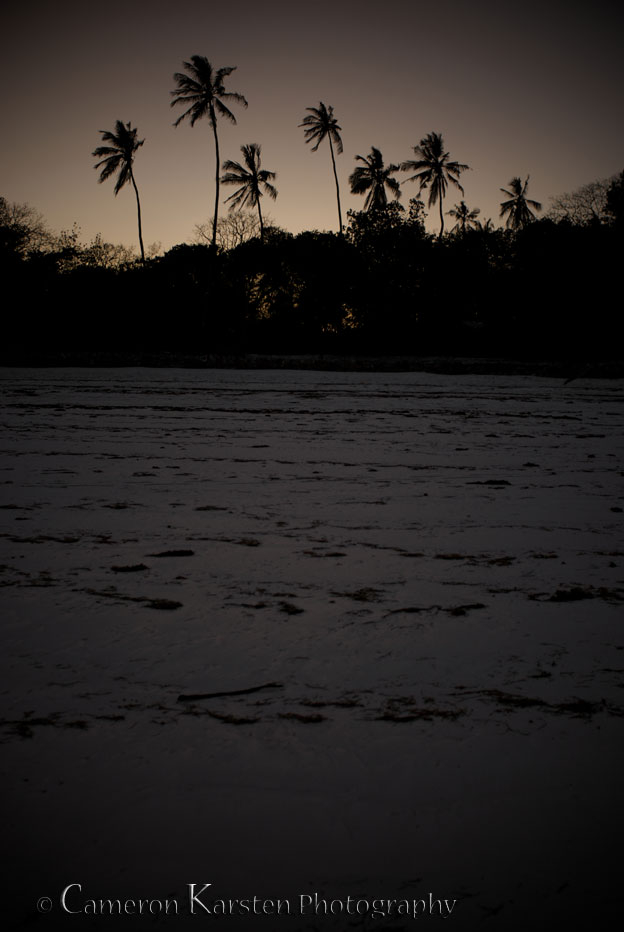
However, as suddenly as human life is extinguished, paradise can be lost. For our African journey—presently exploring the Kenyan coastline of sand, sun and sea—this slippery concept fell from the rocks and crashed into the sea. It came to an end as the same fate threatened our very own lives.
Saturday night. The beach empty. A moon neared its full capacity as the calm waters of Ras Kitau bay lapped at the shimmering sands. There was a man approaching. I watched him with a keen eye. As he neared and greeted, he grabbed my hand and drew me in. Suddenly, his weapon appeared and caught the moonlight above my head. Lily screamed.
Akamba Buses carried us from Nairobi to Mombassa, east to the shores of Kenya. From there we hired a taxi, took the ferry and continued south towards the Tanzanian border. It was dark by the time we got to Ukunda, where we turned left and headed into Diani Beach.

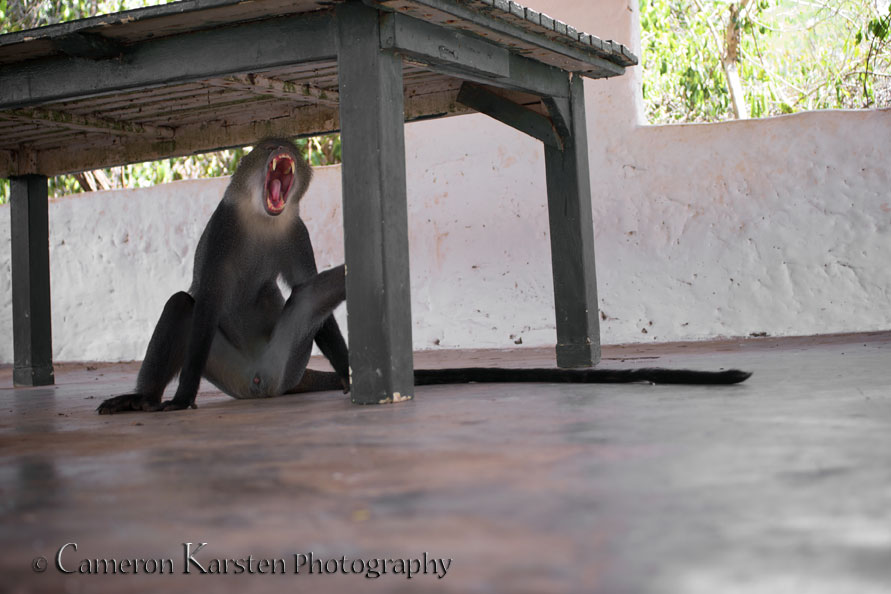
For sixteen days we found home and lived a paradise at Diani Beachalets. For 800ksh a night, Lily and I stayed in a banda, our small cottage, one without electricity, without a fan and with lots of monkeys. When it rained it leaked. And when it rained, the grasses turned green with the scents of earth filling the sea air. We did much of nothing. We read close to ten books a piece. We lounged on the beach in the sand and up on the grasses upon wooden plank chairs. We walked the beach. We swam. We met our traveling neighbors and exchanged stories. We explored the strip of Diani Beach, shopped and prepared our meals morning, afternoon and evening, fending off the marauding primates. It was rustic; that yearned for simplicity the traveler craves. And with it all, we immersed ourselves in the local culture.
“Rafiki, rafiki! Jambo!” A tall lean man slowly walked towards us. “Howz yo day, brotha?”
“Good, good. The ideal holiday.” And it was. Lily and I were sprawled on the beach under intense sunrays. Heat penetrated and sunk into our bodies, causing perspiration to spew from every pore. Every ten minutes we rose to cool in the crystal shallows of the Indian Ocean.

“Yah, brotha. This is good, the good life.” There was an awkward silence. Then he continued. “So brotha,” he started squatting next to me. “I’m a business man and wanted you to promote me.” His name was Alex, aka Coolio. He was our trusty Kenyan Beach Boy. Others exploited us, ran away with our cash. Beach Boys like The Kenyan Busta Rhymes and Simple Max offered their services, granted us trust and then never came around again. But Alex was different. He was real. I could look into his cloudy eyes and see honesty. With most you couldn’t.
“You know,” he began, “Many Beach Boys smoke heroin and look for their money. They will scam and they will run.”
“Like your friend Busta Rhymes?”

“No man, he is different.”
“Really?” Lily asked. “How could he be different? He took our 700ksh and left.”
“His family, you know. One just died of malaria.” Alex nodded his head. “Really.”
“Ohhhh,” we replied suspiciously. Yet we trusted him. We bought homemade sandals, which his mother made for us. And we bought bracelets for friends, a personalized wooden sign and a keychain pendant, along with a batch of fresh coconuts. One day, as I was stepping onto the beach, I saw him whistling to a shell.
“Alex, what the hell you doing?” I figured he was just stoned, whiling away his time.

Alex looked up. “Hermit crabs, you know, they like the whistle. When you whistle, they come out. They say hello to the whistle.” Only in paradise can you find hermit crabs dancing to a melodic whistle.
We met more Kenyan Beach Boys in other places. Vasco de Gama and Omar were brothers, partners in dhow sailing. We became closer with them then Alex as the two Kenyan sailors helped us, supported our emotions in a time of need, and showed us their seas with respect. Vasco was a local from Lamu. Omar was a local from Pate Island.

Paradise can often be confined to a generalization: Isolation. Relaxation. Serenity. Peacefulness. Even a Corona advertisement—sun, sand, turquoise waters, your lover, and (for me) a Negra Modelo with two lime wedges. Paradise varies as often as the clouds of the monsoons, and each can be described differently. Lily and I lived our paradise in Ethiopia within the metropolis of Addis Ababa to the desolate Hamer region, and on to the comforts of Nairobi towards the beaches of Diani. Then we transitioned and came away with a little less baggage and a lot more awareness.
From south to north; Diani above Tanzania to Lamu below Somalia. We bused it. We ferried it. And we arrived, carried away to a beach on an island in the middle of nowhere. We expected another paradise and saw it. It was Shela Beach on Lamu Island at the Sunset Guest House. For six nights we had the top floor terraced-bedroom complete with electricity, multiple fans, a solar heated shower and refrigerator. In fact, we had the entire accommodation to ourselves, and what often felt like the entire seaside.

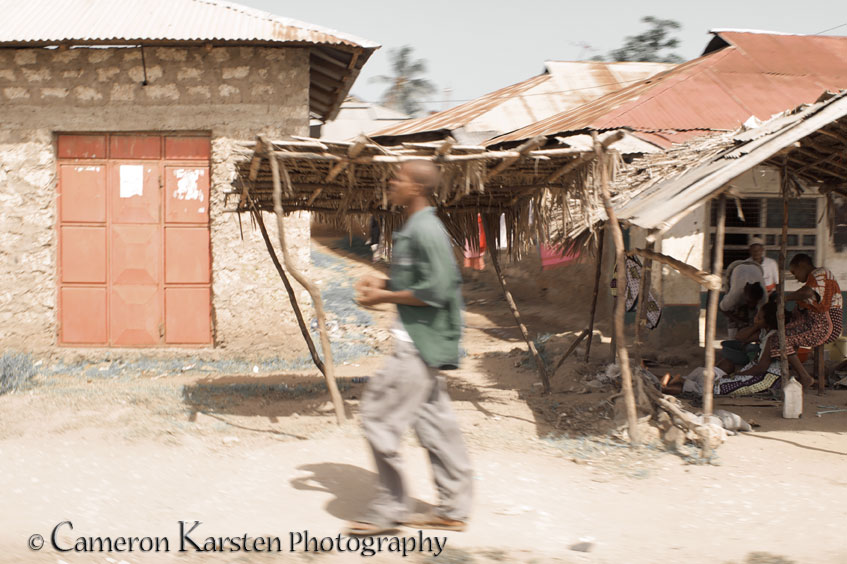
Lamu is a UNESCO World Heritage Site. Narrow winding alleys, exquisitely carved wooden doors lining coral pathways and the bustling Arabs with the men’s flowing white gowns and the women’s mystic black bui-buis (traditional Islamic head scarves), each sparkling in the fierce village lighting. The town is enchanting with scents of humanity harvesting, preparing and cooking spicy Swahili dishes. Mix the aromas with various loads of donkey dung, cat shat, raw prawns and decomposing red snapper, and some squashed cockroaches into the perfume and viola—a rustic seaport ripe with tradition. Only two cars exist on the island—one belonging to the hospital, the other to the police station—therefore the colony of donkeys dominate transportation, together with the fleets of dhows and long narrow motor boats.
Saturday was such a day for exploring the civilization. Lily and I bought our groceries at one of the two shops and drank a fair share of fresh juices from coconut and sweet lime to tamarind. It was late by the time we were heading back, too late. We had to cross the DMZ between Lamu town and Shela Beach, a forty-minute walk passed the jetty, along a boardwalk and onto the sandy beach. It was dark. The moon was waxing. The stars danced silently to the whispers of the sea.
As I stated, Lily and I were alone on the beach. It was approximately 7:30PM. I had on a backpack stocked with groceries and my camera was slung on the outside across my shoulder. We were close to Shela Beach, too close.
Suddenly a man neared. He approached, held out his hand in the dark and spoke, “Jambo!” I returned the gesture and in a strange manner felt him draw me nearer. As I looked into his white eyes, I felt his hands trembling over mine. He was repeating something in Swahili. He was expressing desperation, appearing possessed. Then, he pulled me closer. I tried to step back, withdraw my hand, but it was too late, too close, too dark.
The stranger was dressed in a traditional red-plaid kikoi (sarong), with a white tank top and a shirt wrapped around his head like a Sikh turban. I remember his hands being strong, his biceps pronounced. He was dark, a real dark black, and was wielding a panga, or an axe, in the local Swahili language. Suddenly, Lily screamed as the man swung the weapon above my head and moved his other hand over my throat.
It was a blur, caught without Time, experienced on a supposed utopian island in the middle of nowhere. Lots of money flowed to the island thanks to tourism. Big hotels. Fancy restaurants. Old merchants descending from the rich Arabic economies of the 16th and 17th slave trade. And adjacent to the affluence was desperation.
With happiness there is neighboring sadness.
Inside paradise exists hell.
For when there is light there is darkness.
Lily and I were momentarily shoved into the middle of these juxtapositions, where duality persists, the truth of our humanity flickers, as well as the fragility of human life.
My image remains to this day: a man trembling, chanting, bewitched with terror, swinging an axe toward my skull, threatening my life’s blood to spill upon the wet sands of heaven. He was aiming for my head, my shoulder, my chest. And he still spoke his mantra as I deflected the attempts with one hand, struggling to escape from the grip upon my throat. Lily still screamed. She shouted. Her soul fought for comprehension through a decibel unheard of. The man was obviously thrown off by her reaction, which I hardly heard, for my world was silent, my head clear, my vision of the axe sharp in the moonlight. Suddenly, with a push, the man stumbled back and his hand slipped from my throat. The axe came down.
It was odd standing there, utterly calm and serene, conscious and at peak awareness. Lily was still screaming fifteen feet away. She was crying and began heaving. The man was standing some twenty feet away in the other direction; the axe in one hand and an object dangling from the other. I stared at him. He stared at me. Lily continued and began shouting. Then, he turned and ran. I watched him the whole way, sprinting from the beach up into the bush, until disappearing. I turned to Lily and moved towards her, wrapping my arms around her sobbing body. We turned into each other and then walked away briskly, grateful for living, for each other.

We were alive. We were in shock. Yet the man had obtained one important element of my soul. That object dangling from his grasp, which had recently slipped off my throat was my camera—a Nikon D200 carrying a 28mm Nikkor lens with a polarized filter, an 8GB RiData Memory Card with over 300 priceless photographs of Lamu and one Nikon Li-ion Battery Pack. Total value: $4000USD. I felt as though I lost a limb. I still feel the loss today—a creative eye devoid of expression, a career lacking the necessity to continue, but a life saved and another thief existing in darkness, another personal hell thriving in paradise. The duality of Mother Nature exists in the paradise experienced and remains in a paradise lost. The journey ends with a certain death; metaphorically in terms of creation and purpose, and literally among family and friends.







The African Toll Roads: Buses, Trains & Bajajs Part I
February 9, 2010 by 2 Comments
 A little Harrari girl approached the five of us and to each one spoke the following: “Fish have no legs. Donkeys have four legs. Cows have four legs. And antelope have two horns. Now give me birr!” Her factual data and explicit demand caused me to think about the reasons of travel. We travel to absorb, to broaden the mind and expand our human consciousness. We move to progress, one hopes, in a forward direction, evolving with new skill sets and creative tools. We explore to simply discover the blossoms of unknown territories in mind, body and spirit.
All these are our hopes, what we dream for in the essence of travel. The faerie tale of imagination arrives with blue skies and dazzling African sunsets. It’s angelic for a moment, and then in the next it suddenly drops that burning ball upon your head, setting the whole damn scene ablaze. The hellish places a traveler ends up and the conniving spirits he meets help create the spectrum of an evolving consciousness. Here in Africa, this whole process is called The African Toll Roads, where all paths lead somewhere and often to lands undesirable.

Dark and early, our 4AM pick-up arrived on time to deliver our scrambling flock of pigeons to Selam Buses located on the southern edges of Addis Ababa. We were awake and animated, wound up like a Jack ‘n the Box with thoughts of adventure beyond the city of The New Flower. Three million people with diesel and congestion and gulches oozing scents of death, the countryside was our destination. By 5AM we were nestled in our seats; engines alight, the city smog disappearing.
An easy 10 hours thru rolling chat hills brought Lily, Ivy, Alazar, Henry and me to the far eastern corner of Ethiopia to the great walled city of Harrar. It was the afternoon and the sun shone amidst spotty clouds. As we disembarked, a kind young man calling himself Dawit appeared.
“Welcome to Harrar,” he said in soft English.
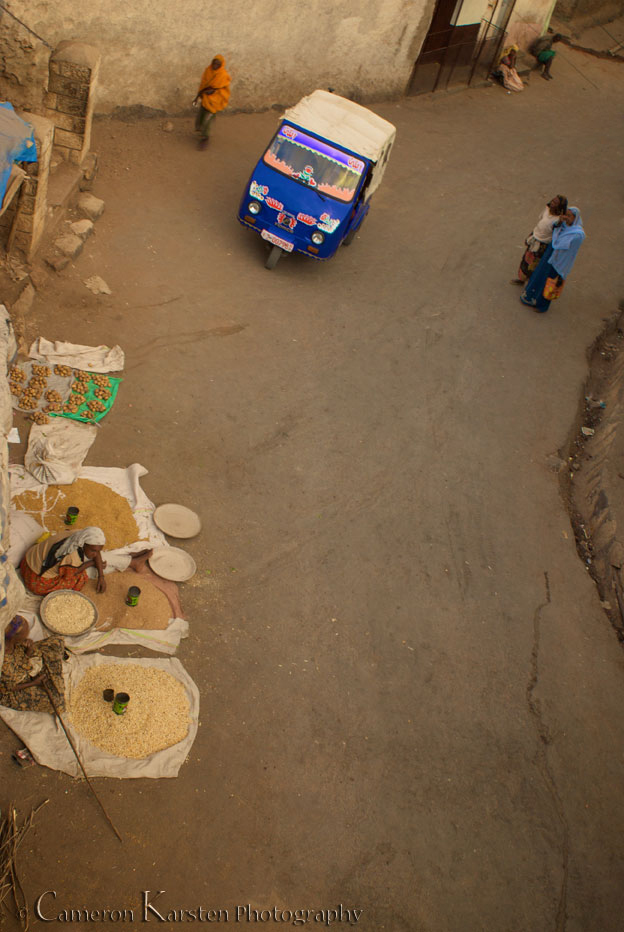
Harrar is history. Today it is an independent city-state within the Federal Republic and once was crowned the largest market in the Horn of Africa, uniting Indian, Middle Eastern and African merchants. It is unique. It welcomes literary and exploratory persons like the late French poet Arthur Rimbaud and British explorer Richard Burton. And its’ one square-kilometer interior is a maze of some 400 alleyways that hides 82 mosques contained within a 16th century wall. Besides, the nightly ritual involving the feeding of the local hyenas raises hairs.
We smiled at Dawit and at the wall towering before us. “Come,” he said. “I will show you your hotel.”
Settled behind the thick five-meter high barrier, we made camp in a traditional Adare guesthouse. Dawit naturally was hired as our guide. He was 17 ½ years young. Calm, quiet, spoke only when asked questions or had something of historical importance. “I go to Addis Ababa University in September and study Tourism. In one year,” he relayed, “I will have my license and be a guide all over Ethiopia. I want to travel and see my country.” With his kind, mild-natured mannerisms, it was hard not to accept Dawit into our adventure. “So 6PM I come and get you. Then, we walk to the hyenas.”

Questions gushed from our thoughts: How many will there be? Why do they come? How long has the ritual been occurring? Are they aggressive? Have travelers ever been mauled? Dawit informed us, but promised we had to wait and see.
The Night of the Dogs
Radiance rose from the horizon, encircling a glow of fleeting shadows. Appearing peacefully, but with assertive force, it lit a background of silhouettes. Wiry branches hung over us like timid ravens, and with each passing minute, colors transformed from yellows to creams to a crisp white as it climbed higher with patience. Eerie in the African night, the hyena feasting would be broadcasted below clear skies clutching a full moon.
Yussouf sat on his rock in the foreground, cradling a plastic jug full of sega (meat). He gave out a shout, then whistled, followed by more shouts as he called the individual names. We waited, watched with skepticism, curious among the unresolved facts. In the past, tourists and locals have been attacked. Hyenas live by their stomachs, and when stomachs talk, the animals feed at will.

In the distance an outline stirred. It approached cautiously, then quickly, before halting in dim light. Like a statue from the Serengeti, the spotted hyena was massive, resembling a common Great Dane but with muscles to flex, shortened hind beef-legs and an elongated neck as thick as a tree stump. Its’ eyes glowed green in the dark.
“That’s a female,” a white man said beside us. His name was Marcus and he was from Eastern Australia.
“Are you traveling?” I asked.
“No, actually. I’m on research.”
“Researching what?” Our attentions turned from the wild dog.
“Hyenas and their interactions with humans. I’ve been here for four months and have at least eight left.”
The five of us, including Dawit, listened closely as the first female and then the next approached from out of darkness. “Muslims have a special connection with hyenas. It’s believed they scare away gini (or evil spirits). To be a Muslim and to be attacked by a hyena is often not a bad thing, that is, if you survive with all your limbs.”
Marcus continued as we each stared at the beasts. They were huge and approximately 40 lived within the area, and only 15-20 feed each night. They lived in a forest around three kilometers from Harrar and you could tell their age by the presence of spots: the older one gets, the fewer spots it retains.
Yussouf, one of the few remaining feeders in Harrar, stabbed a piece of raw cow meat on the end of a 12-inch stick and held it out to the night. Slowly, the larger of the two drew nearer before snagging the flesh between its jaws. He knew each animal by name, and they each knew him. Yussouf fed them from this stick in his hand, from the stick in his mouth, from behind his back and to the sides and even teased them, provoking the hyenas to jump or draw close enough to stroke their meaty necks.
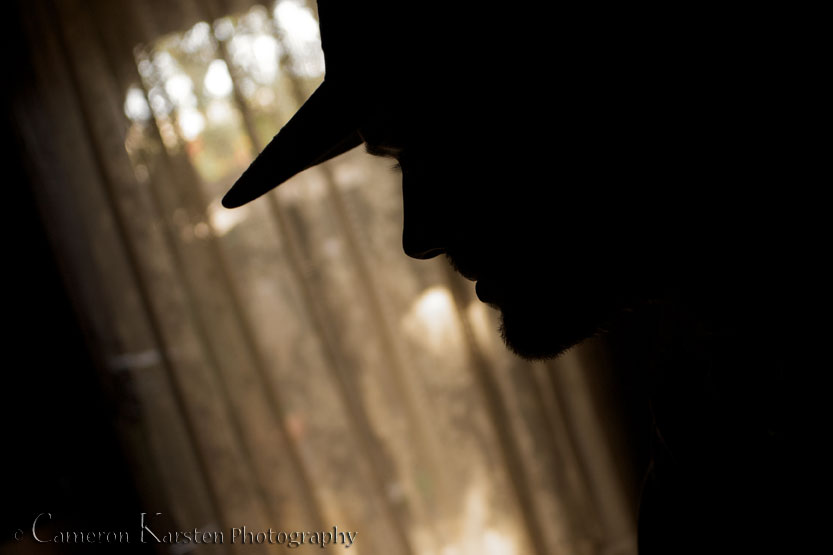
“Spotted hyenas don’t exist outside Sub-Saharan Africa and their numbers are declining as farmers widen their fences and protect their livestock.”
“How long do they live?” I posed.
“Well, in the wild maybe only 10-12 years.” Marcus paused as we each took turns feeding them with sticks: Ivy, Alazar and me with a stick in our hands; Lily with the stick in her mouth.
“But here in Harrar,” he added, “They can live anywhere from 17-23 years.”
Ferenji Feast
The following day we wound our way through the labyrinth of alleys. Dawit led us from site to site; exploring the six different gates, reaching Rimbaud’s palace, Ras Tafari’s honeymoon shrine, Ras Makonnen’s dingy abode, as well as Sheikh Abadir’s tomb who was one of the city’s greatest Islamic scholars.
“Ferenji, ferenji!” we heard.
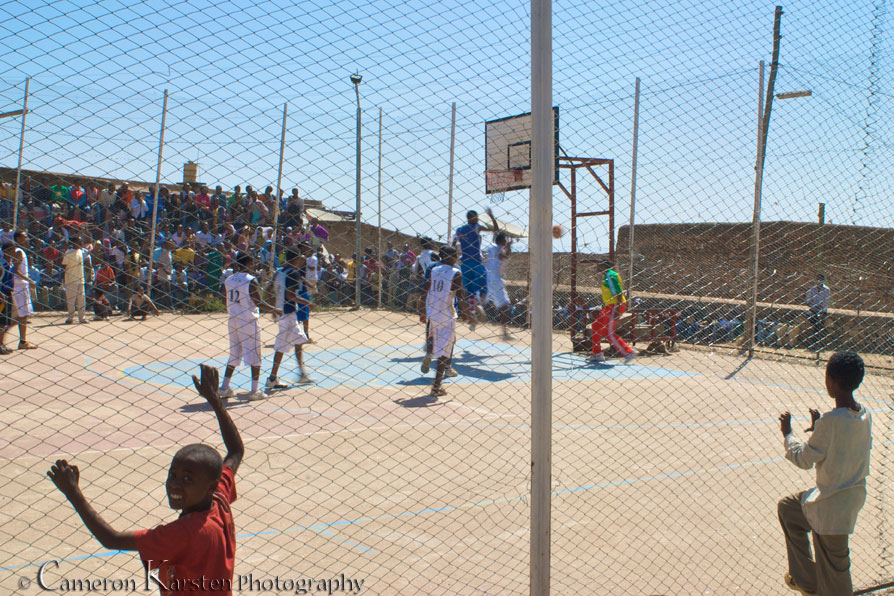
Everywhere, we were accosted. “Foreigner, foreigner,” they shouted. Kids, babies, parents, elders, beggars, people, and I swear even the donkeys. Wherever we went we had a following with humanity asking for money, food, our water and clothes. They wanted to show us around, lead us in this direction, take us here, show us there. They expected payment for the finger pointing. Exhaustion was the effect. It wiped us out, sent our eyes to the ground and our emotions soaring above and out of the walls. Eventually it caught up to us.
As we were resting in the main square of Feres Magala drawing a crowd as if we had fainted, a man grabbed Dawit by the neck and hauled him across the street to a barred courtyard.
“Where’s Dawit going?” Ivy asked.
Henry shrugged his shoulders. “Dawit looked back and frowned, but said nothing.”
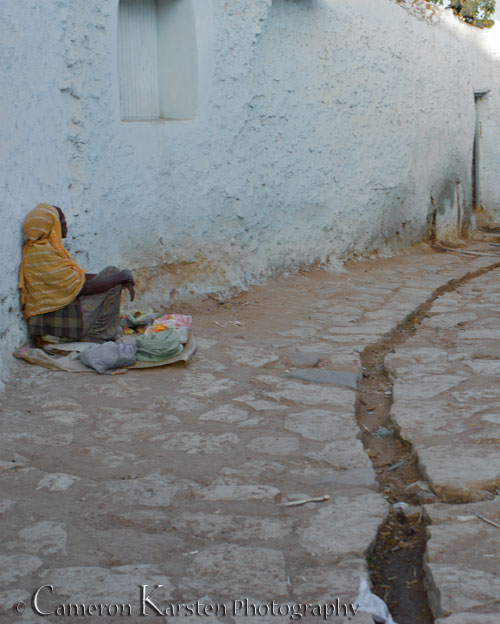
Shortly, Ivy was at the gate holding her three-year old Ethiopian son Alazar whom she adopted over a year ago. “Why did you take our friend?”
“He has no ID card. He can’t be a guide. It is illegal in Harrar.” The man stood out of uniform before the local police yard. Two soldiers flanked his sides wielding AK-47s.
Now these police obviously don’t know much about Jewish culture. Ivy was raised strict Orthodox. Her facial features resemble it. Her gestures and speech are heavily accented. “Dawit is our friend,” she stated. “We’re taking him to lunch because we came here from Addis to visit Dawit, not have him as our guide.”
“No. Impossible,” the policeman demanded. “Dawit and others can’t walk with tourists without ID card as guide.”
“Because the color of our skin?” Lily was appalled. “Because we’re white, and he’s black… you’re saying we can’t be friends?”
“Yes, this is true.”
“Haven’t you heard of evolution?” she retorted.
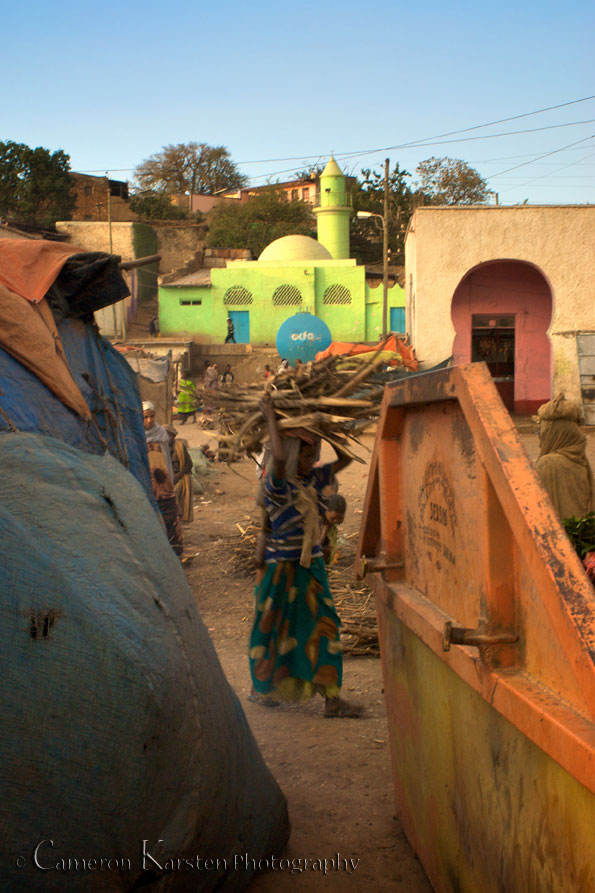
Ivy chewed him and then she chewed him some more. Next she unleashed Alazar from her arms to retrieve Dawit while she continued chewing. Now, Alazar is habesha (he’s native Ethiopian—a.k.a. black). Due to Ivy and Alazar’s relationship we drew more attention then imaginable. So, as Alazar slipped by the guards and ran towards Dawit, Ivy chewed and spit out the policeman like a fly caught in the grill. Then she pointed to Alazar. “See, he is our FRIEND! Alazar, my three year old, knows this.”
At this stage Alazar was pulling on Dawit’s arm to come while guards pushed back the crowds with the butt of their rifles. We were drawing that attention, and the policeman wasn’t pleased. There was little choice as the Jewishness in Ivy persisted (I say this as a generalization and a stereotype of the Jewish individuals I know. Determined, confident and fully driven, this personality trait is a force of strength).
The Chat of Society
As the ferenji with the habesha son, along with the case of Dawit’s arrest and immediate release, might have been the chat of Harrar, the little shrubbery so well known in these parts was the real chat of the town. Some said the best Ethiopian chat came from the fields outside Harrar. Others said the north was where the sweetest and most pleasant chat existed. But it was no question within an Ethiopian’s mind that a rebellious goat near Harrar was the first to discover chat’s intoxicating effects.
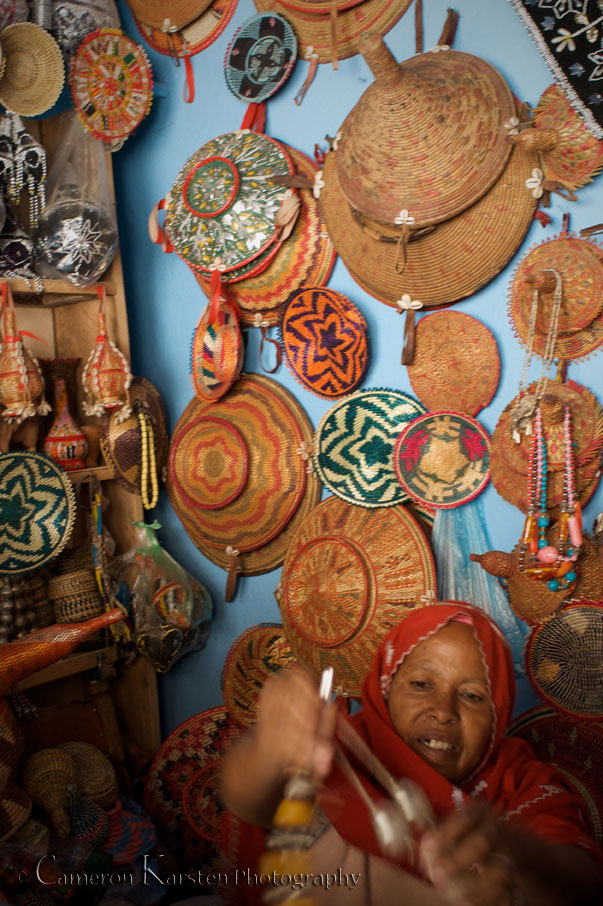
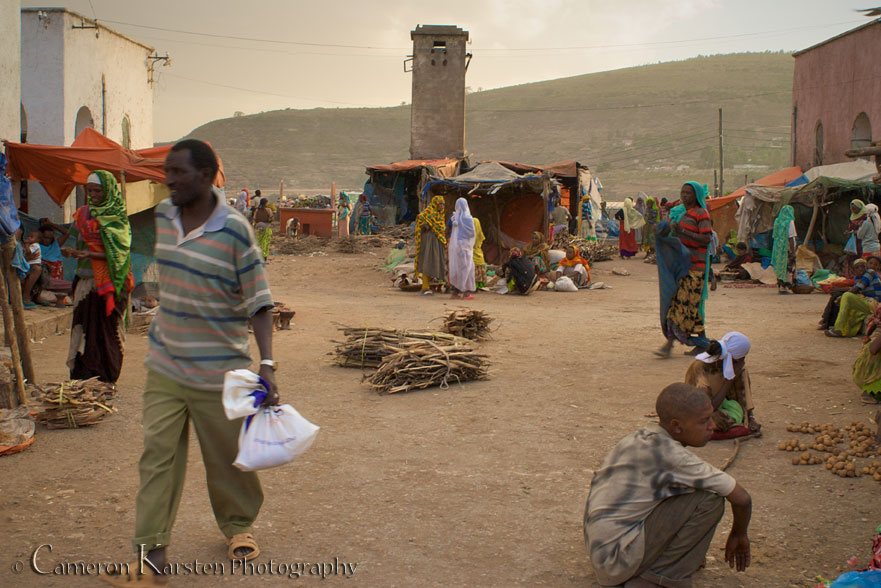
Chat was everywhere, and everywhere were men shipping, moving, hustling, purchasing and chewing the bitter leaf. As we happened upon the miasmic little chat market outside the walls of Harrar we bumped into two well-versed youths.
“Ya man, you wanta chew the chat man. C’mon, ‘tis the Sunday, the day of the chat, and I invite you as friends.”
They looked ridiculous in their baggy clothes. They acted ridiculous with their melodramatic slurred speeches. Ridiculously crazed men whom chewed chat 24 hours a day, 7 days a week surrounded them. And one of their names was ridiculous.
“No. Just looking.”
“But no man, we chew chat. We have nice place to chew together.” He was pushy. “Don’t pussy out man. My name is Fajaja.”
Most of our group was not in the mood, yet others were certain. Fajaja and his Rasta-wannabe friend Dawit ended up escorting us with a bag of chat. What first matured into a chilled out rest within the cool confines of a local’s home transformed into two hours of chat, hookah and coffee ceremony until we were finally slapped with a slip of paper from the one and only Fajaja. “Read this ‘an pay man. Peace be with you, brotha.”
It was a bill. And they were asking for 250 birr.
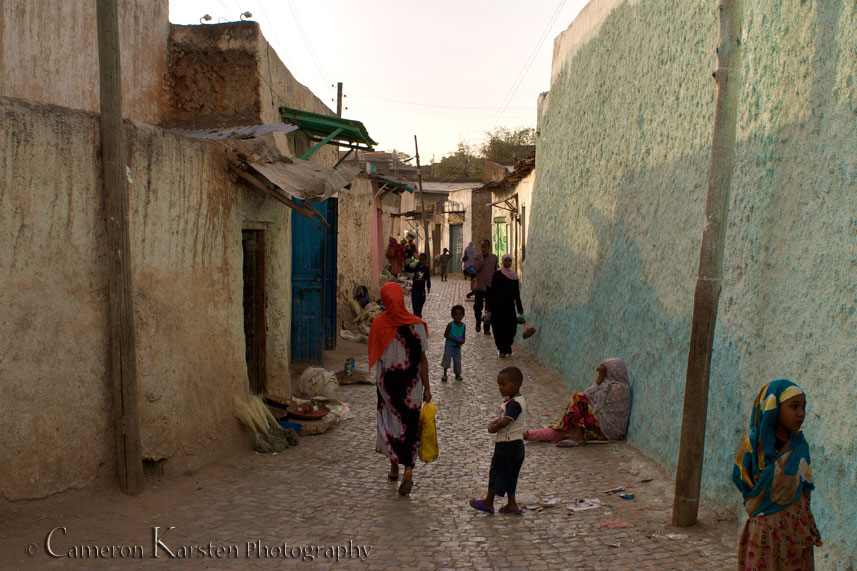
Prior to this surprise, we questioned the two what they did in Harrar. “We’re hustlers, ya know.” Huge false smiles spread across their chat-full cheeks. “We make money however we can.”
Great. Good company.
“Now you pay and don’t be stupid,” they replied as we read the paper and tossed it to the ground.
“Ah no. We’re leaving. Chow!” Ivy brought out her best Jewish and before long there was an argument brewing. “You invited us as friends! And there was no indication we had to pay! And now you want 250! And you still call us friends! You don’t cheat friends like that!”
“Ya,” Fajaja puffed, “But the money is power, so pay up!”
“Yeah, and guess what buddy; we’ve got the money.”
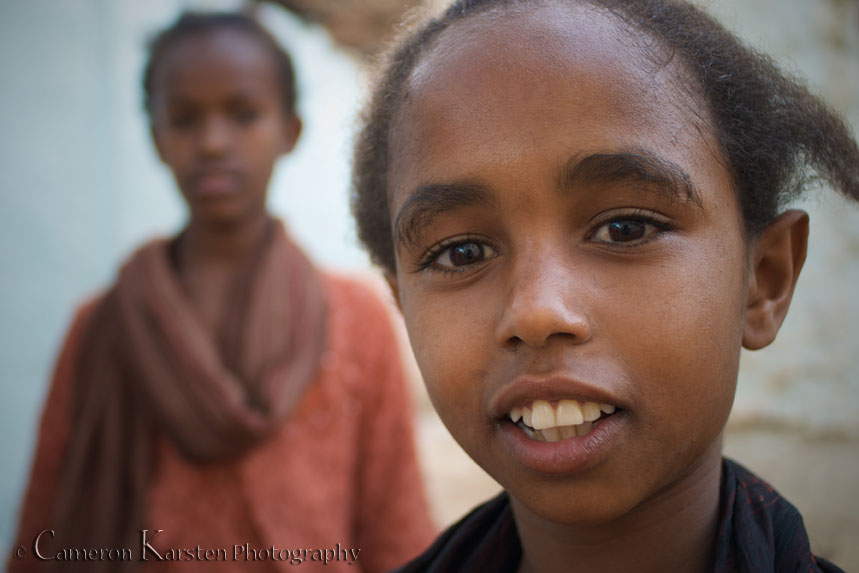
Harrar was left with a bitter taste, one of chat and money-pinchers and beggars from the varying social ranks pulling at your limbs. In a society whose export was equal to an annual income of roughly $17.8 million in chat, it was no wonder the capital of this shrubbery brought the people to their knees pleading for help: Anything else to ease the pain will suffuse, after the ephemeral afternoon under the spell of chat wore off.
Tired, exhausted—we departed Harrar onward to Dire Dawa giving our little friend Dawit the best wishes. He said one thing before we paid him and that was this: “Some say Harrar is The Paradise of Donkeys. True there are many donkeys, but one can look at it from many ways.”
Fish have no legs. Donkeys have four legs. And antelope have two horns. Now give me birr! We were about to find out how many legs we had as The African Toll Roads continued to other tracks.
Waking in Addis Ababa
January 17, 2010 by 4 Comments
Addis Ababa sneaks up on you under the cover of darkness and smashes into your senses at the first light of day. Molasses mixed with gasoline and diesel spews from exhaust pipes, filling the grills of the public lines packed with humanity. Everything under the African sun thuds into 250 square kilometers of valley and pumps out a life bursting with tenacity. Dirty, dusty and polluted—Africa’s 4th largest city is… surprisingly easy. Catch a minibus from the roadside to a nearest transport hub and in an hour the whole sprawl is at your fingertips for less than a dollar (at the time of writing, 12 birr equals one US$1). Hiking trails along the outskirts dot mountaintops. Splashes of exotic cuisine from local injera to pans of pizza pie ring the clock. Shopping malls for the elite and markets for the audacious (the Merkato being Africa’s largest) is vibrant with traditional to global commerce. And nightlife thumps with labels of alcohol from around the world.

So how do you begin to navigate a rumpled city of 3 million people?
The answer: Step out onto the street, buy a bag of avocados from a vender, sit down on a stool to spoon a mixed juice (called spress) down your gullet and take a stroll. Wander. Breathe. Smile at the smooth faces of Ethiopia. And ask lots of questions. You’re sure to find an answer.
Lily and I were riding a minibus to the Merkato. Caught up by the innocent face of a child hung over the seat before us, I started photographing. Everywhere in the city, strangers touch the heads of young kids as a sign of admiration. In general, adults are physical. They grab fingers when talking. Arms wrap around shoulders. Men walk together hand in hand as friends. People care for people. Children care for children. Society is one grandiose family, including the homeless who gain their wages begging in the streets for their days’ meals—and they make it.
As we poked at the giggling youth, other passengers paid attention and brought the child’s cheeks from brown to maroon red. Shortly, we reached the market; disembarked and walked into what the majority of locals (called habisha) and all foreigners (known as ferenge) consider the most dangerous neighborhood in all Addis Ababa.
A man on the bus who paid his dues to the enchanting youth turned to us. “What are you doing here?”
Lily and I looked at one another. “We’re here for the Merkato.”
The man gazed thoughtfully and nodded. “Yes. Really?”
“Really.”
On the ride we had learned of the man’s character. He graduated from Addis Ababa University in journalism and was an avid runner. “Do you know Kenenisa Bekele?”
No.

“But the Jamaican sprinter you know? Really?”
We nodded. “Yes. Usain Bolt, the current record holder.”
“But not Kenenisa?”
We shrugged.
“Eshi. Eshi. Okay, I will take you through the Merkato. My name is Endalk.”
This is the essence of Ethiopian kindness. For three hours Endalk the Journaling Sprinter led us through a maze of alleys, shops and culture. However, being a Sunday in a country of Orthodox Christians and devote Muslims, the market was low-key; not the expected miasmic chaos of an African bazaar deemed the largest of such a continent. We felt safe. We felt calm. Yet faces turned towards ours while eyes beamed into our souls. Undoubtedly, Lily and I were the only western individuals pasted white in a sea of slick black, and we were the only ones carrying backpacks seeping of a camera, two US passports and wads of cash.
Endalk was searching for a job. “There is no work in this country. I have a major in my studies, but still I find little. Look at all these people with nothing!”
Bodies were everywhere—clean, dirty, ragged and crisp. Humanity was thriving in all the ways possible.
“Then what do you want to do?” I asked. “If there’s anything, any kind of work available, what’s your dream job?”
“I want to write for a newspaper, editorial and political topics; but you know, there is no way around the government. They own. They control.”
In the hours of strolling, our conversation ranged from the political to the orthodox to the relaxation of companions from varying cultures familiarizing one another. Before long, we’re facing a group of Endalk’s friends in a small chat hut.
“Come in and sit.”
The room was square, roughly 4 feet by 5 feet, crammed with six bodies.

Chewing chat with a cluster of warm-hearted strangers in Ethiopia is akin to nirvana. Lily and I were out of the sun in cool shade, hydrating our bodies while resting our feet with a cheek full of chat among new friends.
The four men didn’t speak a lick of English, so Endalk translated. “They know you have a strong head on your shoulders and big hearts. They want to invite you to a coffee ceremony at their house. Will you come?”
Swallowing, we nodded. “Of course,” we answered.
Smiles, laughter, Obama claps, and chat. We took our leave under the wing of Endalk and continued exploring.
One deranged thing about Addis is a crosswalk. In the West, crosswalks symbolize the movement of feet and the respect of self-transportation. Engines halt. Machines rest. Bipedals progress. Yet in Addis, like most otherworldly metropolises, the foot passenger is at the bottom of the food chain while spewing beasts of metal, steel and oil surge to the top lost behind the obscurity of their blindfolds. Cross streets with care. Look both ways, then look again in both directions before stepping into the streets. Remember: Don’t hold your breath, and at the slightest breach of traffic (and with keen judgment in self-care) shuffle swiftly. Cars won’t stop and buses won’t forgo their passenger’s eye; in fact, drivers will accelerate at the sight of your vulnerability. It’s all or nothing when crossing a busy street, especially in darkness when impaired judgment is tenfold like a deer in headlights.
So be a wise mammal, one with a head on its shoulders and a big warm-blooded heart. Breathe in the African air, even when passing those green rivers that emit the scent of raw feces stirring in an eternal batch of brown foam. And don’t mind the random dismembered goat heads lying in the ditches and the rocky dirt roads torn asunder by torrential rains. Remember to smile, be brave, and realize we’re all one people. When in Ethiopia, give praise to the culture’s independence, which arises from a history that bubbles with creation and sustenance. Sweetness is aplenty in Addis Ababa, a city whose English translation means “New Flower”. She is a beautiful one indeed.


 Cameron Karsten's Imaginarium