





The African Toll Roads: Buses, Trains & Bajajs Part II
February 14, 2010 by 2 Comments
 We were enveloped in a disruptive blackness. Somewhere, in the Horn of Africa, our carriage rested, while inside our bodies contorted uncomfortably on plastic benches. Supposedly, this was First Class. But our butts, backs and remaining body parts disagreed in Western fashion as the hours of darkness slowly ticked intermittently between quick slumbers of exhaustion. One person stirred, which caused a domino effect of passengers waking, rustling, and repositioning themselves into something vaguely tolerable.
Outside was more of the same. Shouts of Afar and Somali traveled in chaotic yellow beams of flashlights that sliced into the night air. Above, the skies were clear as stars glistened in their full desert regalia. They encircled a waning moon that reflected what little light there was, forming silhouettes of the surrounding landscape. We were found in the middle of a moon-like terrain of barren rock cast across a few craggy knolls.
I opened my eyes wider, shifted from one numb butt cheek to the other, and pulled a blanket over my shoulders. I was beyond drowsy. In fact, I was at the point where operating a vehicle would be certain suicide, and most likely resultant homicides. But as I peered out the barred metal window and felt the cool breeze blow across my face, I saw movement. First, people were hurrying toward their cars with urgency. They were shouting, ordering, jumbling gibberish in languages without pause. Individuals began to board and take their seats; on benches, USAID canvas sacks, filthy floors and gritty aisles, narrow armrests and even luggage racks above our heads. What was a train of silence suddenly erupted into a frenzy of fear. Next, I felt what we were each praying for: metal grinding upon metal as forward progress resumed in a jerky motion along the tracks.
It was the Ethiopian border and for approximately four hours the train remained immobile. People needed their passports, visas, exit stamps and a thorough investigation of luggage, merchandise and belongings by unidentifiable officials asking for money in the midst of darkness. It all made little sense: the processes, the order, the time wasted and the time lost. People were everywhere with their possessions, which appeared identical and were amassed wherever space permitted.
But what mattered was we were moving, crossing the Ethiopian border into Djibouti after being on the country’s only railway for over twelve hours. We were three-fourths of the way there. We had to keep reminding ourselves when we were not unconsciously lost in a faraway dreamland that we were closer then we had ever been. And yet from the Ethiopian side of customs, we shortly arrived to the Djiboutian side of customs to only discover another segment of time gone by sitting, waiting, contorting, complaining, cursing and half-ass sleeping the experience away.
This was the one and only train in all of Ethiopia. The only operating and functioning train service. Upon learning of its existence, a few of us were set on the experience.
Henry looked over at me, “Apparently the trip takes thirteen hours.”
“That’s not what I heard.” Ivy had another source. “It’s anywhere from twelve to twenty.”
 Well, they were both wrong. On the morning of our departure from Dire Dawa in Ethiopia’s eastern desert, our traveling pod of adventurers rose at 6AM, crossed the street from the Makonnen Hotel to the train station at 7AM, proceeded to wait two hours until 9AM boarding (at which time the train was scheduled to leave), and succumbed to further patience for another two hours until the journey eventually began. Then we rolled, maxing out at 35 kilometers per hour (roughly 21mph) and went through moonscapes of scraggly rock, parched earth, flat deserts dotted with boulder-sized termite mounds and inconceivable towns located in the middle of Narnia. There would be absolutely nothing except dirt combed by sun and wind, and then suddenly a town of decrepit granite would appear like apparitions from the Stone Age.
Worst of all, we were unprepared. Typically at a train stop, whether at a designated station or in a town with a population exceeding five, there were usually options for sustenance: food, water, tea stall, donkey ride, and more. However, to our grumbling stomachs of astonishment there was nothing. No food vendors passing through the carriages. No water bottles without seals broken. No portable shai (tea) women toting plastic mugs and cups. Nothing. So we rationed. We counted our last crumbs and announced the last droplet of water from our bottles. Then we waited and waited and fell asleep in hunger.
Djibouti Ain’t Djibouti-licious
Desert, towns, mischievous youths cursing foreigners, more desert, nightfall, darkness, Ethiopian border, customs, Djibouti border, customs, darkness, sunrise, moonscapes and atlas Djibouti City. It was 8AM. Our trip began 26 hours ago at 6AM the previous morning. We needed a hotel.
Djibouti City is neutral. Military vehicles from the stretches of Europe to the expenditures of America and across the plains of the Asian steppes roll through traffic circles. Muslims, Christians, pasty Westerners and tan Orientals suck in sweet juices and gorge on fish. Djibouti is the stomping ground for the Middle East. It enables instant access to Yemen, Sudan, and other desert lands to be spied, inspected and shelled. That being said, as fatigues and jeeps stacked with rotating M16s maneuver through the afternoon gridlock, prices skyrocket while shorthaired men and women pushing foreign currency open their wallets for seafood, gelato, pricy swimming pools and accruing bar tabs.
Our reason for traveling to Djibouti, other than spending too much money and riding the gruesome train, was to renew our Ethiopian visas. So, first things first, in a cool marble-laden room, and after the initial papers and precautionary questions, three of us secured our six-month multi-entries and then dispersed into the heat.
Expectations: Djibouti is smokin’ hot lying at the edge of the Red Sea and between the deserts of the Sahara and the Middle East.
The Reality: Djibouti is like any other dry climate, nothing special, nothing extreme.
Mohammed owned the building where our base in the Djibouti Hotel sat. He was from the country, moved to Norway, but returned for the lifestyle. I asked him about the weather. “Two weeks ago,” he began, “It was so so cold. Sweaters and jackets all in the streets.” I imagined a cold spell for the Death Valley. “But now it is just cold with long sleeve. The weather is getting stranger and stranger. I don’t understand. Sometime really hot, and then next week sometime really cold.”
“And what of Norway?” I pressed.
 Mohammed was pouring a liter of coke into a thermos filled with Jack Daniels. “Norway is farthest from hot and beyond cold.”
No matter what Djiboutians thought, the weather was tropical. We walked. We were hot. We perspired and eventually sought the refuge at the most expense swimming pool south of Casablanca. For $60, Lily and I afforded us a 3-hour dip in the pool and a quick float in the swells of the Red Sea. With all the travel, the micromanaging, the bumps and bruises and stresses and confusions, the azul-tiled eclipse pond overlooking a port called Djibouti rejuvenated our battered souls.
And what else of Djibouti? Nothing besides locals opposed to photographs, the arches of the European Quarter and the wooden pillars of the African Market. We wandered the streets at 2PM when all commerce, movement and evolution froze under the daily spell of freshly arrived chat from Ethiopia, and we got lost in the mazes of narrow alleyways filled with textiles, fabrics, over-sized garments and Taiwanese-made plastic waste. We bought supplies for food and then promptly left, visas in hand, water bottles full and expectations weary.
Reversing the Toll Roads
It was 4:30AM and we were on the side of the road waiting for our bus. Another early morning as we boarded, waited and sweated in the rising heat. Then we shifted as our return journey commenced.
Opting out of the train, instead we caught a bus to the Djiboutian customs, crossed the border and unloaded on the Ethiopian side. Hours wasted, waiting, wondering, until packed like sardines with no concern for the paying fare, our transportation departed. Thus the most uncomfortable bus journey jostled for ten hours down a gravel road paralleling the railway we rode three days prior. The same termite mounds. The same desert, towns, curious locals and security checkpoints, including the ionizing remains of three Soviet tanks leftover from the Derg Invasion of 1972-‘89.
Dire Dawa came, then Dire Dawa went with an overnight minibus adventure to our starting point in Addis Ababa, which suddenly transformed into the most comfortable, loving, easy-going, nonchalant city in all of Africa. A final taxi ride at 5AM after eight days of travel brought us home to our beds safe and sound, despite the obvious intoxication of our driver. Our African Toll Roads paid and passed, we crashed and spent the entire day in bed.

The African Toll Roads: Buses, Trains & Bajajs Part I
February 9, 2010 by 2 Comments
 A little Harrari girl approached the five of us and to each one spoke the following: “Fish have no legs. Donkeys have four legs. Cows have four legs. And antelope have two horns. Now give me birr!” Her factual data and explicit demand caused me to think about the reasons of travel. We travel to absorb, to broaden the mind and expand our human consciousness. We move to progress, one hopes, in a forward direction, evolving with new skill sets and creative tools. We explore to simply discover the blossoms of unknown territories in mind, body and spirit.
All these are our hopes, what we dream for in the essence of travel. The faerie tale of imagination arrives with blue skies and dazzling African sunsets. It’s angelic for a moment, and then in the next it suddenly drops that burning ball upon your head, setting the whole damn scene ablaze. The hellish places a traveler ends up and the conniving spirits he meets help create the spectrum of an evolving consciousness. Here in Africa, this whole process is called The African Toll Roads, where all paths lead somewhere and often to lands undesirable.

Dark and early, our 4AM pick-up arrived on time to deliver our scrambling flock of pigeons to Selam Buses located on the southern edges of Addis Ababa. We were awake and animated, wound up like a Jack ‘n the Box with thoughts of adventure beyond the city of The New Flower. Three million people with diesel and congestion and gulches oozing scents of death, the countryside was our destination. By 5AM we were nestled in our seats; engines alight, the city smog disappearing.
An easy 10 hours thru rolling chat hills brought Lily, Ivy, Alazar, Henry and me to the far eastern corner of Ethiopia to the great walled city of Harrar. It was the afternoon and the sun shone amidst spotty clouds. As we disembarked, a kind young man calling himself Dawit appeared.
“Welcome to Harrar,” he said in soft English.
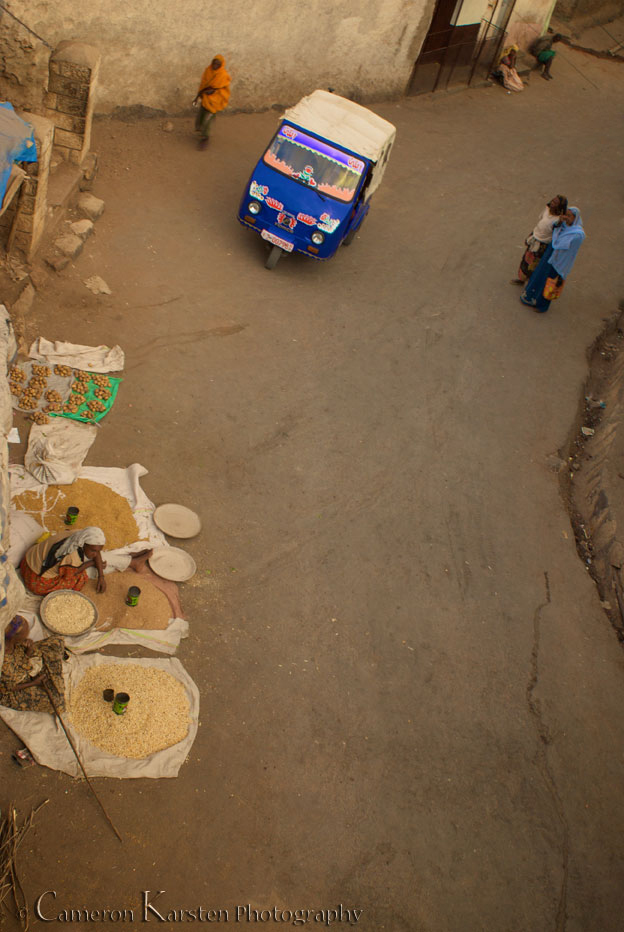
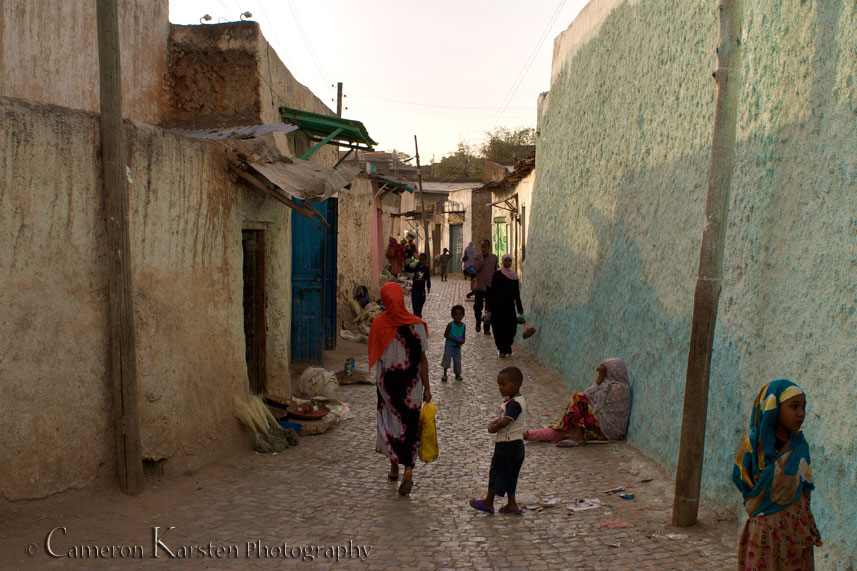
Harrar is history. Today it is an independent city-state within the Federal Republic and once was crowned the largest market in the Horn of Africa, uniting Indian, Middle Eastern and African merchants. It is unique. It welcomes literary and exploratory persons like the late French poet Arthur Rimbaud and British explorer Richard Burton. And its’ one square-kilometer interior is a maze of some 400 alleyways that hides 82 mosques contained within a 16th century wall. Besides, the nightly ritual involving the feeding of the local hyenas raises hairs.
We smiled at Dawit and at the wall towering before us. “Come,” he said. “I will show you your hotel.”
Settled behind the thick five-meter high barrier, we made camp in a traditional Adare guesthouse. Dawit naturally was hired as our guide. He was 17 ½ years young. Calm, quiet, spoke only when asked questions or had something of historical importance. “I go to Addis Ababa University in September and study Tourism. In one year,” he relayed, “I will have my license and be a guide all over Ethiopia. I want to travel and see my country.” With his kind, mild-natured mannerisms, it was hard not to accept Dawit into our adventure. “So 6PM I come and get you. Then, we walk to the hyenas.”

Questions gushed from our thoughts: How many will there be? Why do they come? How long has the ritual been occurring? Are they aggressive? Have travelers ever been mauled? Dawit informed us, but promised we had to wait and see.
The Night of the Dogs
Radiance rose from the horizon, encircling a glow of fleeting shadows. Appearing peacefully, but with assertive force, it lit a background of silhouettes. Wiry branches hung over us like timid ravens, and with each passing minute, colors transformed from yellows to creams to a crisp white as it climbed higher with patience. Eerie in the African night, the hyena feasting would be broadcasted below clear skies clutching a full moon.
Yussouf sat on his rock in the foreground, cradling a plastic jug full of sega (meat). He gave out a shout, then whistled, followed by more shouts as he called the individual names. We waited, watched with skepticism, curious among the unresolved facts. In the past, tourists and locals have been attacked. Hyenas live by their stomachs, and when stomachs talk, the animals feed at will.

In the distance an outline stirred. It approached cautiously, then quickly, before halting in dim light. Like a statue from the Serengeti, the spotted hyena was massive, resembling a common Great Dane but with muscles to flex, shortened hind beef-legs and an elongated neck as thick as a tree stump. Its’ eyes glowed green in the dark.
“That’s a female,” a white man said beside us. His name was Marcus and he was from Eastern Australia.
“Are you traveling?” I asked.
“No, actually. I’m on research.”
“Researching what?” Our attentions turned from the wild dog.
“Hyenas and their interactions with humans. I’ve been here for four months and have at least eight left.”
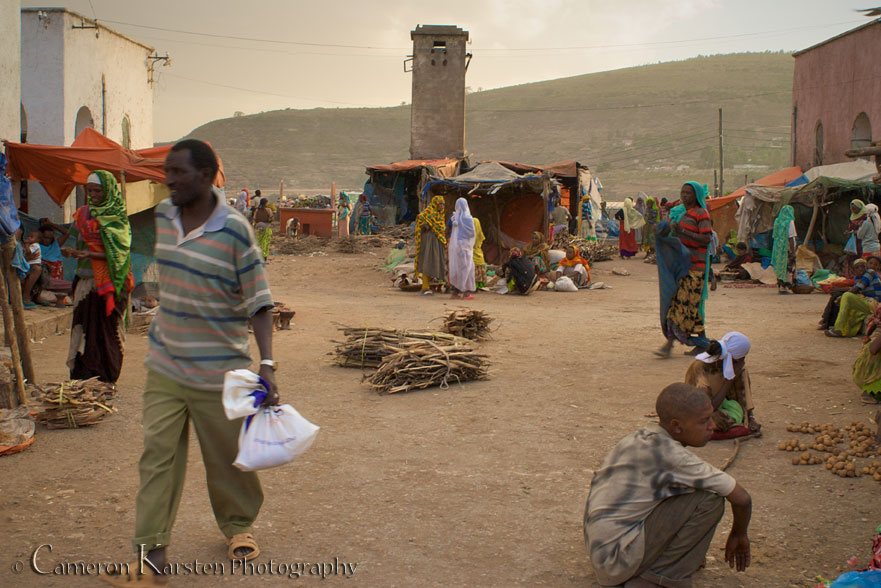
The five of us, including Dawit, listened closely as the first female and then the next approached from out of darkness. “Muslims have a special connection with hyenas. It’s believed they scare away gini (or evil spirits). To be a Muslim and to be attacked by a hyena is often not a bad thing, that is, if you survive with all your limbs.”
Marcus continued as we each stared at the beasts. They were huge and approximately 40 lived within the area, and only 15-20 feed each night. They lived in a forest around three kilometers from Harrar and you could tell their age by the presence of spots: the older one gets, the fewer spots it retains.
Yussouf, one of the few remaining feeders in Harrar, stabbed a piece of raw cow meat on the end of a 12-inch stick and held it out to the night. Slowly, the larger of the two drew nearer before snagging the flesh between its jaws. He knew each animal by name, and they each knew him. Yussouf fed them from this stick in his hand, from the stick in his mouth, from behind his back and to the sides and even teased them, provoking the hyenas to jump or draw close enough to stroke their meaty necks.
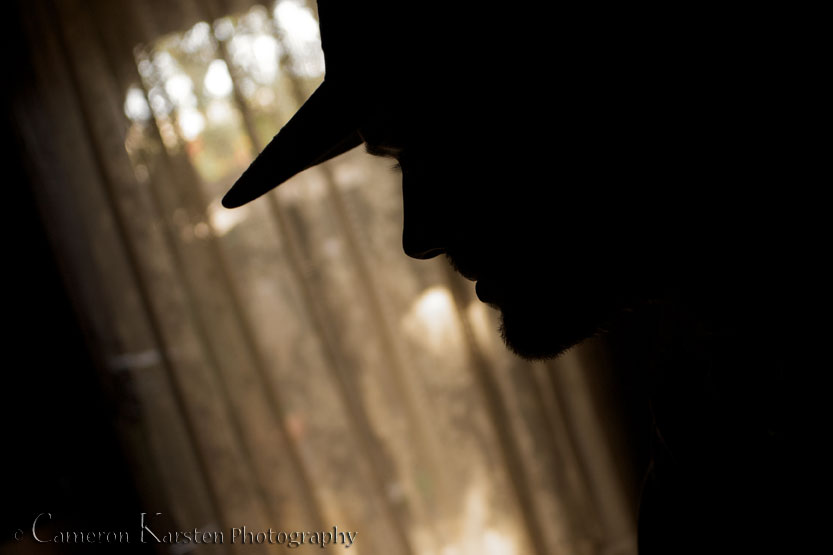
“Spotted hyenas don’t exist outside Sub-Saharan Africa and their numbers are declining as farmers widen their fences and protect their livestock.”
“How long do they live?” I posed.
“Well, in the wild maybe only 10-12 years.” Marcus paused as we each took turns feeding them with sticks: Ivy, Alazar and me with a stick in our hands; Lily with the stick in her mouth.
“But here in Harrar,” he added, “They can live anywhere from 17-23 years.”
Ferenji Feast
The following day we wound our way through the labyrinth of alleys. Dawit led us from site to site; exploring the six different gates, reaching Rimbaud’s palace, Ras Tafari’s honeymoon shrine, Ras Makonnen’s dingy abode, as well as Sheikh Abadir’s tomb who was one of the city’s greatest Islamic scholars.
“Ferenji, ferenji!” we heard.
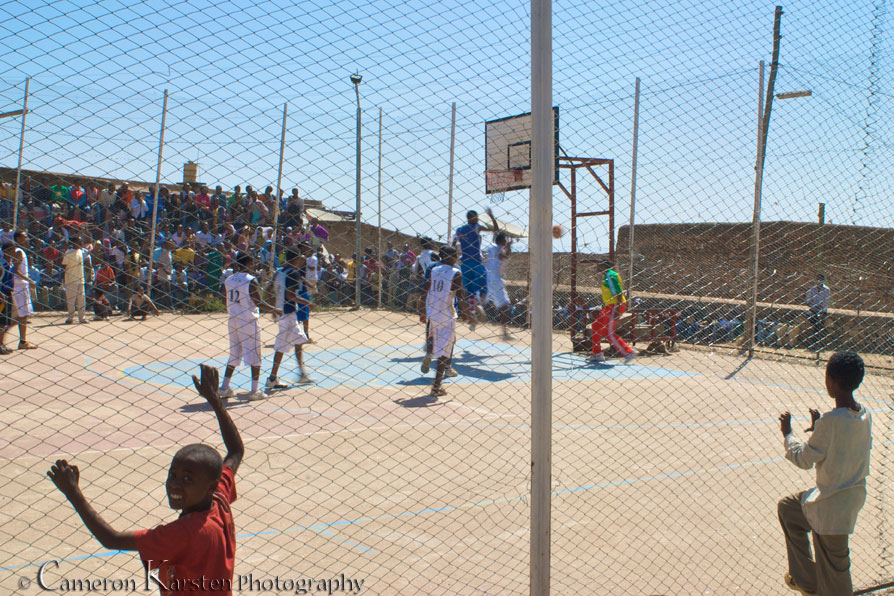
Everywhere, we were accosted. “Foreigner, foreigner,” they shouted. Kids, babies, parents, elders, beggars, people, and I swear even the donkeys. Wherever we went we had a following with humanity asking for money, food, our water and clothes. They wanted to show us around, lead us in this direction, take us here, show us there. They expected payment for the finger pointing. Exhaustion was the effect. It wiped us out, sent our eyes to the ground and our emotions soaring above and out of the walls. Eventually it caught up to us.
As we were resting in the main square of Feres Magala drawing a crowd as if we had fainted, a man grabbed Dawit by the neck and hauled him across the street to a barred courtyard.
“Where’s Dawit going?” Ivy asked.
Henry shrugged his shoulders. “Dawit looked back and frowned, but said nothing.”
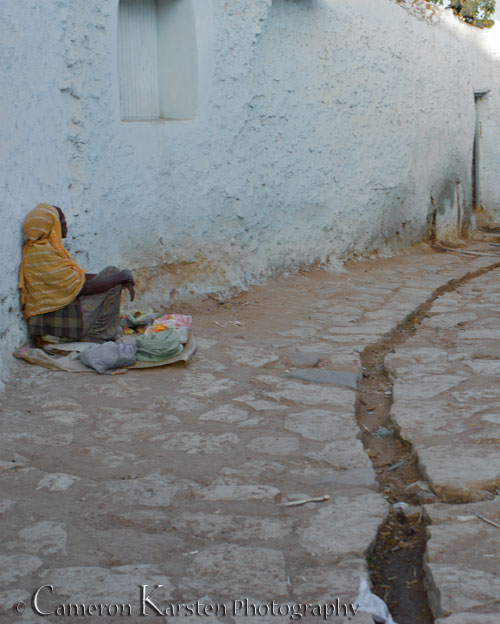
Shortly, Ivy was at the gate holding her three-year old Ethiopian son Alazar whom she adopted over a year ago. “Why did you take our friend?”
“He has no ID card. He can’t be a guide. It is illegal in Harrar.” The man stood out of uniform before the local police yard. Two soldiers flanked his sides wielding AK-47s.
Now these police obviously don’t know much about Jewish culture. Ivy was raised strict Orthodox. Her facial features resemble it. Her gestures and speech are heavily accented. “Dawit is our friend,” she stated. “We’re taking him to lunch because we came here from Addis to visit Dawit, not have him as our guide.”
“No. Impossible,” the policeman demanded. “Dawit and others can’t walk with tourists without ID card as guide.”
“Because the color of our skin?” Lily was appalled. “Because we’re white, and he’s black… you’re saying we can’t be friends?”
“Yes, this is true.”
“Haven’t you heard of evolution?” she retorted.
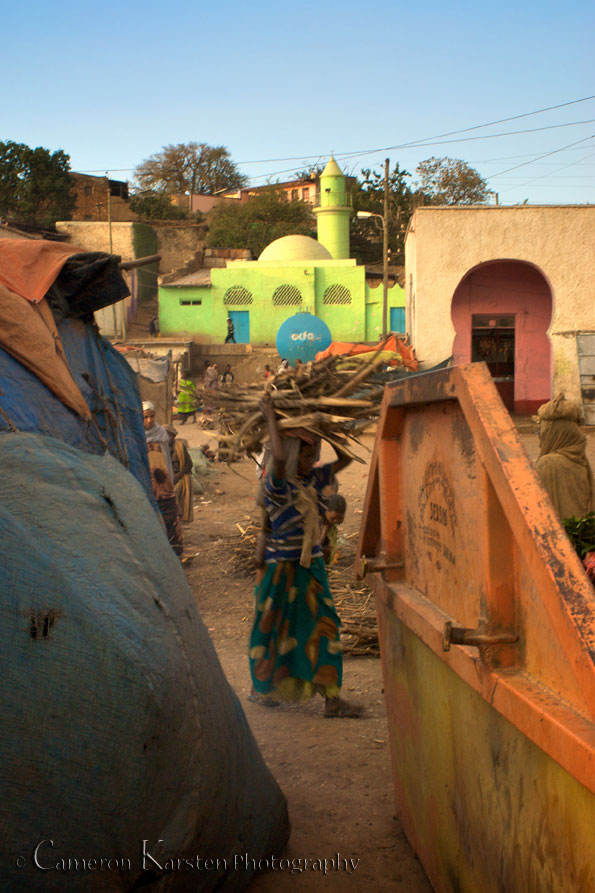
Ivy chewed him and then she chewed him some more. Next she unleashed Alazar from her arms to retrieve Dawit while she continued chewing. Now, Alazar is habesha (he’s native Ethiopian—a.k.a. black). Due to Ivy and Alazar’s relationship we drew more attention then imaginable. So, as Alazar slipped by the guards and ran towards Dawit, Ivy chewed and spit out the policeman like a fly caught in the grill. Then she pointed to Alazar. “See, he is our FRIEND! Alazar, my three year old, knows this.”
At this stage Alazar was pulling on Dawit’s arm to come while guards pushed back the crowds with the butt of their rifles. We were drawing that attention, and the policeman wasn’t pleased. There was little choice as the Jewishness in Ivy persisted (I say this as a generalization and a stereotype of the Jewish individuals I know. Determined, confident and fully driven, this personality trait is a force of strength).
The Chat of Society
As the ferenji with the habesha son, along with the case of Dawit’s arrest and immediate release, might have been the chat of Harrar, the little shrubbery so well known in these parts was the real chat of the town. Some said the best Ethiopian chat came from the fields outside Harrar. Others said the north was where the sweetest and most pleasant chat existed. But it was no question within an Ethiopian’s mind that a rebellious goat near Harrar was the first to discover chat’s intoxicating effects.
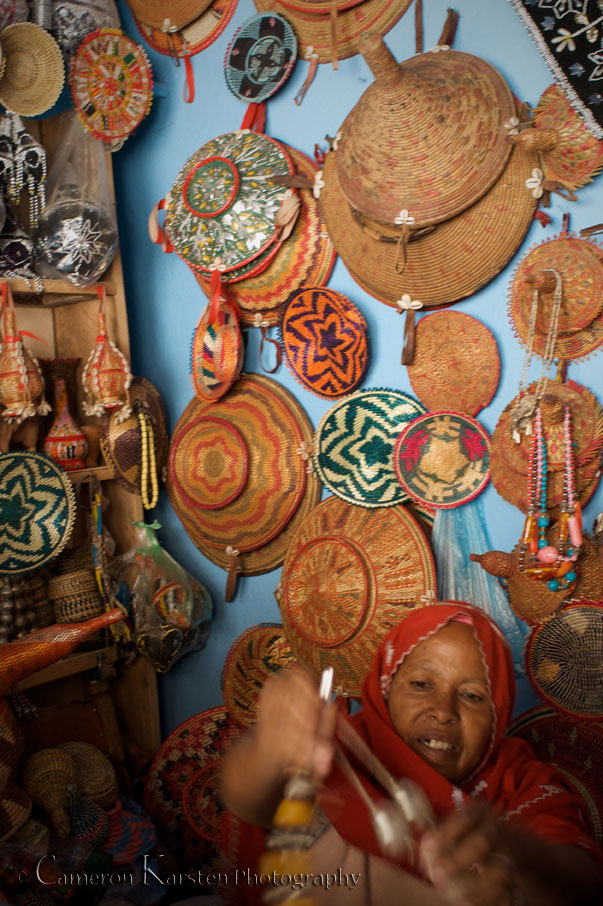
Chat was everywhere, and everywhere were men shipping, moving, hustling, purchasing and chewing the bitter leaf. As we happened upon the miasmic little chat market outside the walls of Harrar we bumped into two well-versed youths.
“Ya man, you wanta chew the chat man. C’mon, ‘tis the Sunday, the day of the chat, and I invite you as friends.”
They looked ridiculous in their baggy clothes. They acted ridiculous with their melodramatic slurred speeches. Ridiculously crazed men whom chewed chat 24 hours a day, 7 days a week surrounded them. And one of their names was ridiculous.
“No. Just looking.”
“But no man, we chew chat. We have nice place to chew together.” He was pushy. “Don’t pussy out man. My name is Fajaja.”
Most of our group was not in the mood, yet others were certain. Fajaja and his Rasta-wannabe friend Dawit ended up escorting us with a bag of chat. What first matured into a chilled out rest within the cool confines of a local’s home transformed into two hours of chat, hookah and coffee ceremony until we were finally slapped with a slip of paper from the one and only Fajaja. “Read this ‘an pay man. Peace be with you, brotha.”
It was a bill. And they were asking for 250 birr.
Prior to this surprise, we questioned the two what they did in Harrar. “We’re hustlers, ya know.” Huge false smiles spread across their chat-full cheeks. “We make money however we can.”
Great. Good company.
“Now you pay and don’t be stupid,” they replied as we read the paper and tossed it to the ground.
“Ah no. We’re leaving. Chow!” Ivy brought out her best Jewish and before long there was an argument brewing. “You invited us as friends! And there was no indication we had to pay! And now you want 250! And you still call us friends! You don’t cheat friends like that!”
“Ya,” Fajaja puffed, “But the money is power, so pay up!”
“Yeah, and guess what buddy; we’ve got the money.”
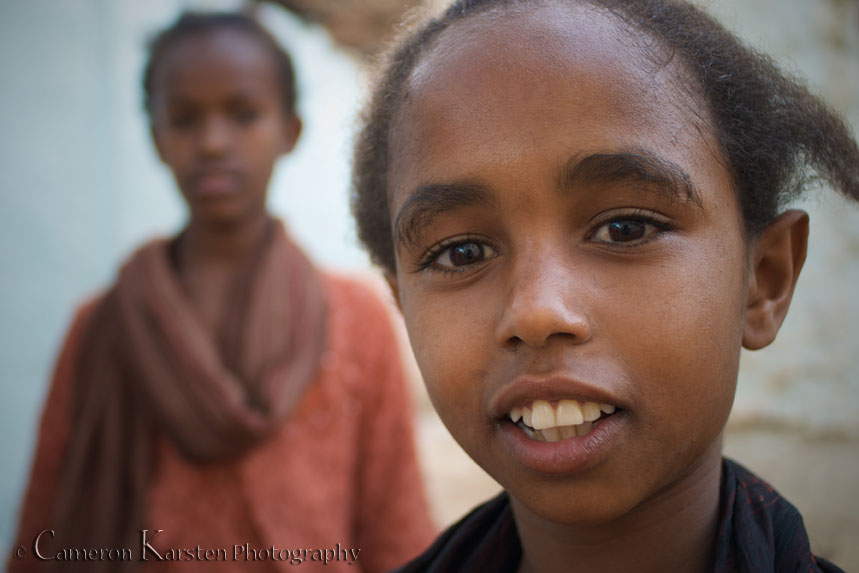
Harrar was left with a bitter taste, one of chat and money-pinchers and beggars from the varying social ranks pulling at your limbs. In a society whose export was equal to an annual income of roughly $17.8 million in chat, it was no wonder the capital of this shrubbery brought the people to their knees pleading for help: Anything else to ease the pain will suffuse, after the ephemeral afternoon under the spell of chat wore off.
Tired, exhausted—we departed Harrar onward to Dire Dawa giving our little friend Dawit the best wishes. He said one thing before we paid him and that was this: “Some say Harrar is The Paradise of Donkeys. True there are many donkeys, but one can look at it from many ways.”
Fish have no legs. Donkeys have four legs. And antelope have two horns. Now give me birr! We were about to find out how many legs we had as The African Toll Roads continued to other tracks.
Waking in Addis Ababa
January 17, 2010 by 4 Comments
Addis Ababa sneaks up on you under the cover of darkness and smashes into your senses at the first light of day. Molasses mixed with gasoline and diesel spews from exhaust pipes, filling the grills of the public lines packed with humanity. Everything under the African sun thuds into 250 square kilometers of valley and pumps out a life bursting with tenacity. Dirty, dusty and polluted—Africa’s 4th largest city is… surprisingly easy. Catch a minibus from the roadside to a nearest transport hub and in an hour the whole sprawl is at your fingertips for less than a dollar (at the time of writing, 12 birr equals one US$1). Hiking trails along the outskirts dot mountaintops. Splashes of exotic cuisine from local injera to pans of pizza pie ring the clock. Shopping malls for the elite and markets for the audacious (the Merkato being Africa’s largest) is vibrant with traditional to global commerce. And nightlife thumps with labels of alcohol from around the world.

So how do you begin to navigate a rumpled city of 3 million people?
The answer: Step out onto the street, buy a bag of avocados from a vender, sit down on a stool to spoon a mixed juice (called spress) down your gullet and take a stroll. Wander. Breathe. Smile at the smooth faces of Ethiopia. And ask lots of questions. You’re sure to find an answer.
Lily and I were riding a minibus to the Merkato. Caught up by the innocent face of a child hung over the seat before us, I started photographing. Everywhere in the city, strangers touch the heads of young kids as a sign of admiration. In general, adults are physical. They grab fingers when talking. Arms wrap around shoulders. Men walk together hand in hand as friends. People care for people. Children care for children. Society is one grandiose family, including the homeless who gain their wages begging in the streets for their days’ meals—and they make it.
As we poked at the giggling youth, other passengers paid attention and brought the child’s cheeks from brown to maroon red. Shortly, we reached the market; disembarked and walked into what the majority of locals (called habisha) and all foreigners (known as ferenge) consider the most dangerous neighborhood in all Addis Ababa.
A man on the bus who paid his dues to the enchanting youth turned to us. “What are you doing here?”
Lily and I looked at one another. “We’re here for the Merkato.”
The man gazed thoughtfully and nodded. “Yes. Really?”
“Really.”
On the ride we had learned of the man’s character. He graduated from Addis Ababa University in journalism and was an avid runner. “Do you know Kenenisa Bekele?”
No.

“But the Jamaican sprinter you know? Really?”
We nodded. “Yes. Usain Bolt, the current record holder.”
“But not Kenenisa?”
We shrugged.
“Eshi. Eshi. Okay, I will take you through the Merkato. My name is Endalk.”
This is the essence of Ethiopian kindness. For three hours Endalk the Journaling Sprinter led us through a maze of alleys, shops and culture. However, being a Sunday in a country of Orthodox Christians and devote Muslims, the market was low-key; not the expected miasmic chaos of an African bazaar deemed the largest of such a continent. We felt safe. We felt calm. Yet faces turned towards ours while eyes beamed into our souls. Undoubtedly, Lily and I were the only western individuals pasted white in a sea of slick black, and we were the only ones carrying backpacks seeping of a camera, two US passports and wads of cash.
Endalk was searching for a job. “There is no work in this country. I have a major in my studies, but still I find little. Look at all these people with nothing!”
Bodies were everywhere—clean, dirty, ragged and crisp. Humanity was thriving in all the ways possible.
“Then what do you want to do?” I asked. “If there’s anything, any kind of work available, what’s your dream job?”
“I want to write for a newspaper, editorial and political topics; but you know, there is no way around the government. They own. They control.”
In the hours of strolling, our conversation ranged from the political to the orthodox to the relaxation of companions from varying cultures familiarizing one another. Before long, we’re facing a group of Endalk’s friends in a small chat hut.
“Come in and sit.”
The room was square, roughly 4 feet by 5 feet, crammed with six bodies.

Chewing chat with a cluster of warm-hearted strangers in Ethiopia is akin to nirvana. Lily and I were out of the sun in cool shade, hydrating our bodies while resting our feet with a cheek full of chat among new friends.
The four men didn’t speak a lick of English, so Endalk translated. “They know you have a strong head on your shoulders and big hearts. They want to invite you to a coffee ceremony at their house. Will you come?”
Swallowing, we nodded. “Of course,” we answered.
Smiles, laughter, Obama claps, and chat. We took our leave under the wing of Endalk and continued exploring.
One deranged thing about Addis is a crosswalk. In the West, crosswalks symbolize the movement of feet and the respect of self-transportation. Engines halt. Machines rest. Bipedals progress. Yet in Addis, like most otherworldly metropolises, the foot passenger is at the bottom of the food chain while spewing beasts of metal, steel and oil surge to the top lost behind the obscurity of their blindfolds. Cross streets with care. Look both ways, then look again in both directions before stepping into the streets. Remember: Don’t hold your breath, and at the slightest breach of traffic (and with keen judgment in self-care) shuffle swiftly. Cars won’t stop and buses won’t forgo their passenger’s eye; in fact, drivers will accelerate at the sight of your vulnerability. It’s all or nothing when crossing a busy street, especially in darkness when impaired judgment is tenfold like a deer in headlights.
So be a wise mammal, one with a head on its shoulders and a big warm-blooded heart. Breathe in the African air, even when passing those green rivers that emit the scent of raw feces stirring in an eternal batch of brown foam. And don’t mind the random dismembered goat heads lying in the ditches and the rocky dirt roads torn asunder by torrential rains. Remember to smile, be brave, and realize we’re all one people. When in Ethiopia, give praise to the culture’s independence, which arises from a history that bubbles with creation and sustenance. Sweetness is aplenty in Addis Ababa, a city whose English translation means “New Flower”. She is a beautiful one indeed.

Seulam: An Ethiopian Welcome
January 12, 2010 by 2 Comments
Italy missed it. The Emperor Haile Selassie created a new legacy. Agriculture flourished with creative inventions of coffee and teff. And people evolved with smiles on faces of unparalleled beauty. Nestled within the Horn of Africa, this land is boisterous and unique; food specialized and faith ingrained deep with the freedom to believe. Home sweet home, Ethiopia.

Twenty-four hours of transit to a different time zone upon a different continent in a world that revolves in different Time, all set in a calendar 7 ½ years behind the West. Add one extra month (which proceeds the month of August) in a yearly cycle of twelve and you find yourself in Ethiopia.
Abraham the driver pulled Lily and me out of immigration, led us to his van and trundled into the city. It was after midnight on our clock, but Addis Ababa read 6:30pm, and on January 7th, 2010, the eve of Ethiopian Christmas Day, the streets were dark. Black apparitions passed among the concrete shadows where little burning fires kept the shelterless warm. Packs of dogs wandered across our van’s headlights, their eyes gleaming with a reflection akin to the haunted, and with a glint of color block office buildings draped with strands of Christmas lighting. An odd mix. A complete disillusionment to Western reality. Breathe in Africa: that moist, dense air set within the exotic power of mankind’s nonsensicality. Suddenly, I relaxed into the adventure.
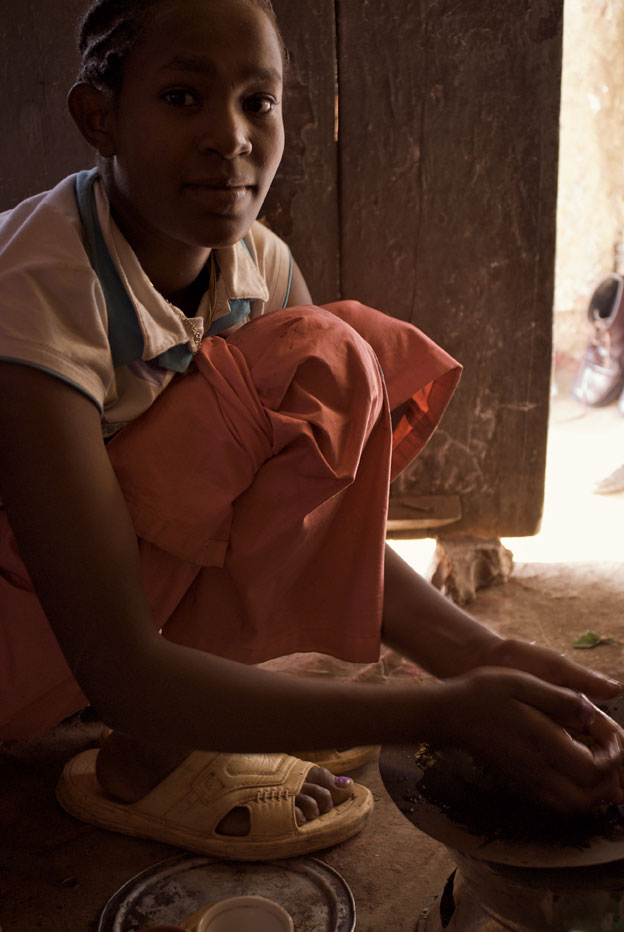
Fast-forward thirty-six hours and our circadian clocks matched. We’re inside a stranger’s house with a friend from home who calls himself Henry Guterson. It was a day of exploration like any day in a foreign city: sumptuous foods, crazed markets, the meters of walking and the barriers of language. Soon we were climbing Entoto Mountain when a spontaneous invitation brought us to a coffee ceremony. Inside the local’s mud hut, the three of us sat on a sunken couch as the family emerged in abundance: Father (abbat) and Mother (ennat) with seven sons (weund lej) and six daughters (sat lej). Their friends crowded in too, staring and smiling. We asked questions. They asked questions. We all used our hands and body language. They understood and we set the groove: Americans and Ethiopians before a dish of roasting beans called buna (or coffee). Over red embers, the green beans browned in a splash of water, releasing a wispy tail of steam and smoke that filled our nostrils with a rich earthy aroma.
“Where you from?” the daughter Yibekal Zewdu asked as she roasted the beans.
“America. We’re all from the USA.”
Faces erupted. “USA is good country. Americans!”
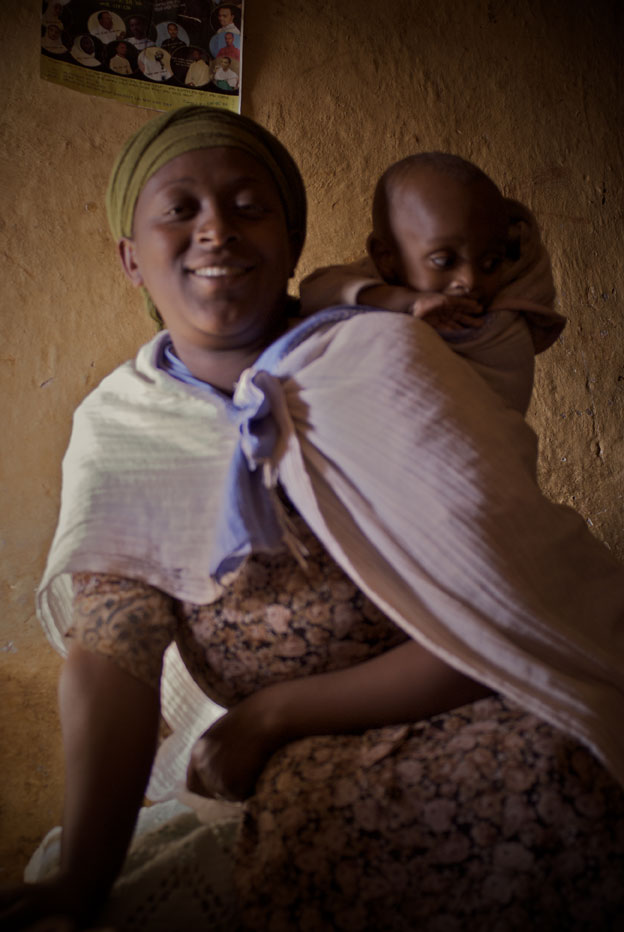
We could see their happiness, their smiles stretching from one ear to the next: A rural family hosting a traditional coffee ceremony for three Americans, passing dabbo (bread), introducing us to their culture with apple-flavored hookah and chat (a mildly intoxicating leaf chewed and packed in the cheek). A scratchy Japanese show played on their television screen as a dusty stream of sunlight poured through the rafters. Nestled in a dark corner was a Christmas tree, constructed from a bouquet of fresh branches and garlanded with the ominous plastic colors of the holiday season.
We sipped our teacups of sweetened coffee. Shortly afterwards the Father spoke.
His language was in Amharic, Ethiopian’s official dialect among some 80 other indigenous tongues, but we quickly understood with the influence of hand gestures and facial features: The sun is sinking. It’s getting late. If you keep climbing, you better hurry, because after dark there is danger for you. He ran his finger across his throat, contorting his face with an open jaw. You must leave.

Later we got the picture. There are jup or hyenas roving in packs in the mountains, and they’re always hungry. So, with a donation for the family’s generosity, Lily, Henry and I took our departure amidst adult handshakes and children kisses. We stepped outside and were bathed in the exquisite African sun, continuing our trek upon an Ethiopian landscape. We each breathed deeper with the sense of cultural freedom. Seulam and chow, my Ethiopian brothers and sisters. Welcome and goodbye until next time.
The Hamar Tribe of Southwestern Ethiopia
December 22, 2009 by 2 Comments
The Hamar tribe of southwestern Ethiopia are a select group of 7,000 – partial nomads, partial settlers – whom have found their community in an evolving catastrophe. For centuries they’ve lived the way the ancestors have survived, following agrarian and goat herding traditions. Today, in the midst of a changing climate with desertification and the encroachment of modern technologies, the Hamar peoples are questioning their survival techniques as starvation, lack of clean water and disease threaten their existence.
I, along with Lily Brewis, will spend a length of time with the Hamar tribe this upcoming February 2010, documenting the changes and adaptation of the peoples via photography, article writing and HD film footage. We will accompanying the Bainbridge Island-based nonprofit Global Team for Local Initiatives (GTLI) who have stepped in to help teach the Hamar to the changing climate, creating water-well projects and sanitation techniques. Below is an introduction to the Hamar tribe and the work the people along with GTLI have in store.
Risking 7 Lifestyles: How To Save For Travel
November 14, 2009 by 1 Comment
The modern world blows, sometimes nice and hard. As a traveler, you must step back and take a look: technology amidst mansions, cars, oils, gases, rising costs of amenities and those heavy monthly bills. Then right beside us there’s poverty, famine, disease, war and constant power struggle. To top it off, all of this costs money, and lots of it.
Contrary to civilization is travel, real travel where the backpacker leaves all wastelands behind to discover new culture, ways of living and knowledge to experience. Thus the traveler gains wisdom.
But in this society, traveling wisdom comes with a cost. It’s no longer free like the age of Basho, wandering with rucksack along trails from shed to shed, over mountain ranges and across rivers. No. Border guards prevent this. Visas, rules and modern transportation make this virtually impossible. But why let them stop you?
Tired of the hustle and bustle, out of money with mounting wanderlust, how do you obtain enough monetary resources to make this happen? Here are a seven opportunities to help hit the road.

First, add up those monthly expenses. What are your bills? An average person is going to have the following dues:
• Rent
• Food + laundry
• Cellphone
• Internet
• Transportation + gas
• Insurance
• Play
The above are the basics of the modern world enabling you to live, work, connect and remain mobile. Depending on your lifestyle you can have monthly bills ranging from the low-end frugality of $1300 to a high-end butterfly of $4000+. But as a traveler, you have to rearrange these priorities, including your values.
Once you have a total, let’s take apart the list and see what can be cutback for the next adventure.
1. Foremost is rent. Rent is a bitch. In the developing world it’s tough to find a studio apartment for less than $600. So what do you do? Housesitting is key. You live for free; in fact you get paid to sleep in others’ homes, taking care of daily routines with cats, dogs, iguanas, maybe a ferocious chimpanzee, and possibly more. Rent is now gone. And with those spaces between jobs there is couch surfing with friends, crashing with a family member, or visiting a long-lost lover.
2. Food and laundry is almost inescapable. You need to eat and most often food costs money. However, if you’re housesitting, make sure you get the go-ahead to indulge the pantry, but go light on the booze. Otherwise, dumpster diving is free and many times generates pirate’s booty. Clothes? Wear what you have.
3. Cellphones are despised in my world. Chuck them towards the depths of the growling sea and give text messaging the Bird. Yet it’s hard to live without, but fortunately cheaper then landlines if you forgo cable television. Find a cheap plan and stay under your minutes.
4. Internet. Cut it. Ever heard of the library? Head there with a laptop for free wifi and surround yourself with travel books. And that housesitting gig? Ask for their router’s password and connect.
5. Transportation is an easy one. Sell your car and buy a bicycle. Check your public bus lines and light rail schedules. You’ll save money and eliminate stress and gas. Help yourself. Help the environment.
6. Insurance might be difficult, especially with rising plans and an indecisive government that simply wants more control. Solution? Get fit by riding that bike and cancel car insurance. Wear a helmet and eat healthy. You’ll suddenly discover $300/month for medical insurance is wasteful. Be your own doctor with something called preventative healthcare.
7. We all need to play. Going out with friends. Dancing at live music venues. Movies, events, museums and recreation are keys to balance in life. But what is more valuable: spending $100/night with friends resulting with head in strange porcelain tub or $3/night for a bungalow on the edge of Thailand’s Andaman Sea? This is a personal choice based on personal experience.
To travel in today’s world, you must reorganize priorities by taking a step back to observe your monthly expenses. What will it take to buy that next plane ticket? You decide. And if you really want it, whatever lifestyle that may be, it’s possible. Travelers know that if there’s a will there’s a way. The most expensive purchase will be that plane ticket to get you started, whether it’s a roundtrip itinerary or the elusive one-way journey casting away those monthly dues.

10 Online Magazines That Survived (& will continue to survive) the Writer’s Market
November 5, 2009 by 1 Comment
 It is often daunting to think of presenting your personality to an audience, whether in the form of art such as painting, drawing or sculpting, down to the very basics of speaking a hand-written speech to a rabble of family, friends and strangers. You express. You divulge in a passion. But are you ready to share?
As a writer, you are an artist with words. They are your tools like a paintbrush is to a painter. And language is your color palette; a vast choice of styles, techniques and individuality. Once the order is composed, the structure aligned and your voice vibrant with character, it’s time to reveal your creation and share.
But how? What’s next is the submission process to expose your artistic skill as a writer to audiences that will gain a new perspective and understanding, and hopefully appreciate your abilities. Below is a list of publications that cater to the adventurous, the culture dwelling, and the storyteller of the senses—lived by travelers, composed by travelers and read by travelers. These peoples are your friends, and they’re hear to assist you in your passion.

Travel Explorations
Want to expose the fearful? TravelExplorations.com is an online magazine devoted to shedding grassroots light where there is media darkness, revealing a culture from behind the iron curtain by true explorers. Real travel. Real adventure. Real investigation by undercurrent people. No mainstream bullshit here.
Editor(s): Geir Moen & Stein Morten Lund
Submissions: Compose an article about your adventure, an exploration—a journey into the heart of “darkness”. Spice it with your soul at 1,000-1,500 words and email the symphonic words to Stein@TravelExplorations.com
Inside Out Magazine
By backpackers and the independent wayfarers, this bimonthly publication is for those who prefer the new versus the old. Instead of consuming, collecting and rotting within the four walls of daily routine, sell your shit, hit the road with a new lifestyle on your back and begin exploring the cultures of this planet. Ready to share? InsideOutMag.com
Editor(s): Helene Goupil
Submissions: Briefs, tips and facts; destinations to languages, health to the traveler’s life—pull your words into a structured alignment for the budgeteer and send it off to submissions@insideoutmag.com. Upon publication you’ll receive $10-$20 for your expenses.
Go World Travel Magazine
“Honest, down-to-earth descriptive writing” is the focus of this magazine. Prizing intelligent composition, GoWorldTravel.com wants more than the How to get there and the What to do. They want the picture of a back alley in Fez painted in twilight mood and a spice market within Kashmir to tickle your nose and water your eyes—all with words.
Editor(s): Mim Swartz, Rachel Barbara & Sheri L. Thompson
Submissions: Travel within the last two years is good for description, so recall your memory or sculpt a new journey within a 500-1200 word article. Check your facts before shipping it to submissions@goworldpublishing.com. Include article location in the e-mail subject line with your pasted manuscript, word count, brief author biography and whether images are available. $35-$50 upon publication.
The Cultured Traveler
Whether freelance or tour host/travel agency, TheCulturedTraveler.com works around a monthly editorial calendar with theme-based publications searching for stories about the unexpected, the bizarre and the eclectic. Not only anecdotes, but facts, tips and resources are necessary for the all-around traveler’s account.
Editor(s): Patrick Totty
Submissions: With the regal elegance of an opera performance, conduct your language into a 1,000-3,000 word count and invest in the guidelines. Specifics here, so follow the formats on the submissions page and prepare for edits, rewrites and a $25 sum after publication.
Travel Outward
Looking for a story of the senses portraying a unique destination combined with history, culture, people and your own melodic adventure? TravelOutward.com is a place for your craft to evolve, develop and be shared via publication, focusing on that preferred destination. This is not a place to divulge romantic sojourns in the arms of the jet stream’s cherubs, but a community narrowed down to intelligence and knowledge.
Editor(s): Laurence Constable & Harman Stinson
Submissions: Features from 1,500-2,500 words should be attached to an email to Travel Outward as a Word doc. that includes a brief bio with “Submission” in the subject line.

EscapeArtist Travel Magazine
Not for the faint hearted, EscapeArtist.com seeks the daring, the challenging, those who live, travel and express on the edge…possibly the cusp of insanity. But the publication is not out to offend, simply to present intelligent writing about culture with history, purpose and flares of risqué.
Editor(s): n/a
Submissions: An article between 1,500-3,000 words flavored with the ribald and the daring that highlights a cultural expedition through the heart of the unknown. Should be completed and either faxed or sent via email. Check the Article Submission page for specifics.
TravelMag
Welcome to the worldwide writer’s circle of fellow explorers. Set up as an online magazine, TravelMag.co.uk wants whatever you got, as long as it reads well, structured with a unique perspective and offers an angle that is possibly more esoteric than your standard publication.
Editor(s): Jack Barker
Submissions: Travel away, then write away. If your article is interesting, unique, lively, filled with senses and intelligently composed at an approximate word count of 2,000 send ‘err off in an email with accompanying photographs to ed@travelmag.co.uk
InTheFray Magazine
At InTheFray.org, writers are provided with a plethora of categories from reporting international news to travel narratives and today’s evolving art world. This publication seeks everything that is cleverly written and allows readers to be a part of a progressive evolution. Race, gender, activism, sexuality and ecological impacts are center stage.
Editor(s): Vivian Wagner, Annette Marie Hyder, Anja Tranovich, Matthew Heller, Liz Yuan & Naomi Ishiguro
Submissions: Check out the various sections featured in the publication, format your article to its specifics and submit your finalized piece including full name, email address and phone number to the designated editor of your selected category. Pay ranges between $20-$75.
Get Lost Magazine
Seeking travel, adventure, natural history and lifestyle writing, GetLostMagazine.com is an award-winner with stories ranging from the basic facts and tips to the more daring adventure of description and risk. Who eats acorns? One man does, and he chose to write about it, discovering flavors akin to billy goat semen. Not sure about either of those tastes.
Editor(s): Leslie Strom
Submissions: Articles should be under 1,000 words and fall into the distinguished character of “top-notch”. Paste article into the body of an email with accompanying photographs formatted as .jpeg or .gif and send to lstrom@getlostmagazine.com. Don’t expect payment upon publication.
In The Know Traveler
You wanna be In The Know. Readers wanna be In The Know. So get In The Know and write to inspire. InTheKnowTraveler.com’s number one priority is to inspire travel with acceptance and appreciation. Readers of this online magazine want to learn about the world’s diverse cultures and those funky destinations, not in investigative reporting, but in the skillfully written articles about your traveling.
Editor(s): n/a
Submission: Correct grammar and punctuation, somewhere between 400-600 words, and send it on in with photographs to editor@intheknowtraveler.com. Time to get published, but before you receive a whopping $10, be prepared to edit to the editors liking. Then you’re In The Know.

Advice? Keep traveling. Keep writing. Keep photographing. Keep doing whatever you’re doing as long as you’re happy and respecting those around you. You’ll be in the know no matter who publishes you. Such is the traveler’s life.

 Cameron Karsten's Imaginarium