Seattle Central Creative Academy: Photography Assignment (Book Story)

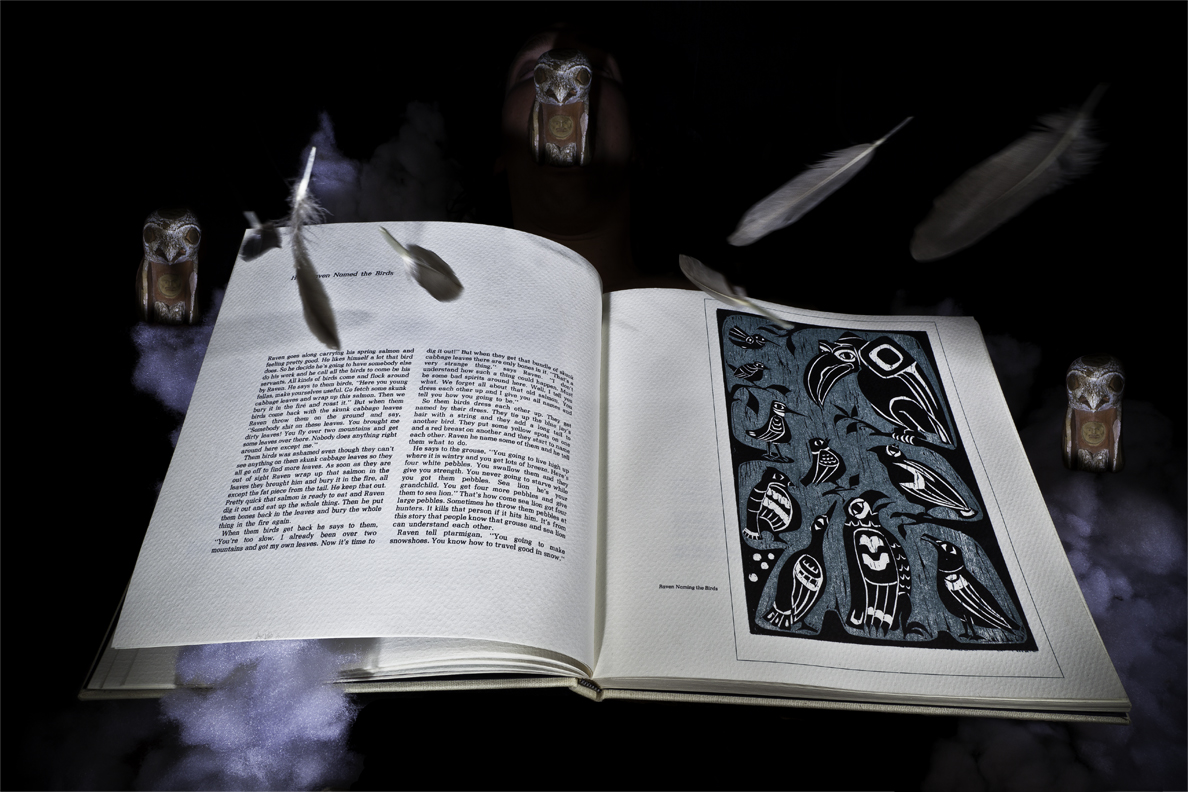
For this assignment we had to practice creating and setting up props to tell a story of a book, whether it portrayed the contents of the book, or a particular message the photographer wanted to convey.  I chose a book entitled Raven of a collection of woodcut art by Dale Burlison De Armond and accompanying parables recorded by John Swanton in 1904.  It is a stunning book, with thick textured paper in a heavy hardbound cover retelling the lost stories of Raven’s mythological significance to Native American culture.  For me this book holds power due to my connection with the bird and its mysterious, resolute rebelliousness, as well as a few personal tales where Raven has played a siginificant role in my life.  The resulting photograph depicts Raven as the creator and destroyer, the creature pulling the strings of our world, playing its game in whatever way Raven wishes.  The book is open to a story entitled, “How Raven Named the Birds”.

The book is elevated on four bricks, allowing me enough room to slide between them and rest beneath the book, giving the perspective of it resting upon my chest.  I cut open a pillow and used its cotton stuffing for clouds and hung various feathers collected throughout my travels on fishing line tied to two c-stand arms above the scene.  They represent the death and rebirth of birds, in this case, rising and falling in and out of the book’s pages.  And signifying the all-powerful bird, I placed Raven in my open mouth as if emerging out of my dead body.  After a number of shots triggered remotely, I was able to merge a few images in PS5 to add two extra Ravens and a few more clouds to the scene.

Location: SCCA Studios, Seattle, WA

Camera/Lens Specifics: Canon 5D Mark II with Canon EF 24-105mm f/4 L IS USM

24mm, 1/13 sec at f/20, ISO 100, tripod mount, trigger fired.

Post: Adobe LR3 & PS5

Seattle Central Creative Academy: Photography Assignment (Selective Focus)

Location: SCCA Studios, Seattle, WA

Camera/Lens Specifics: Canon 5D Mark II with Canon EF 24-105mm f/4 L IS USM

105mm, 1/250 sec at f/4, ISO 1000, table mount.

Post: Adobe LR3

Seattle Central Creative Academy: Photography Assignment (One Light Product Shot)

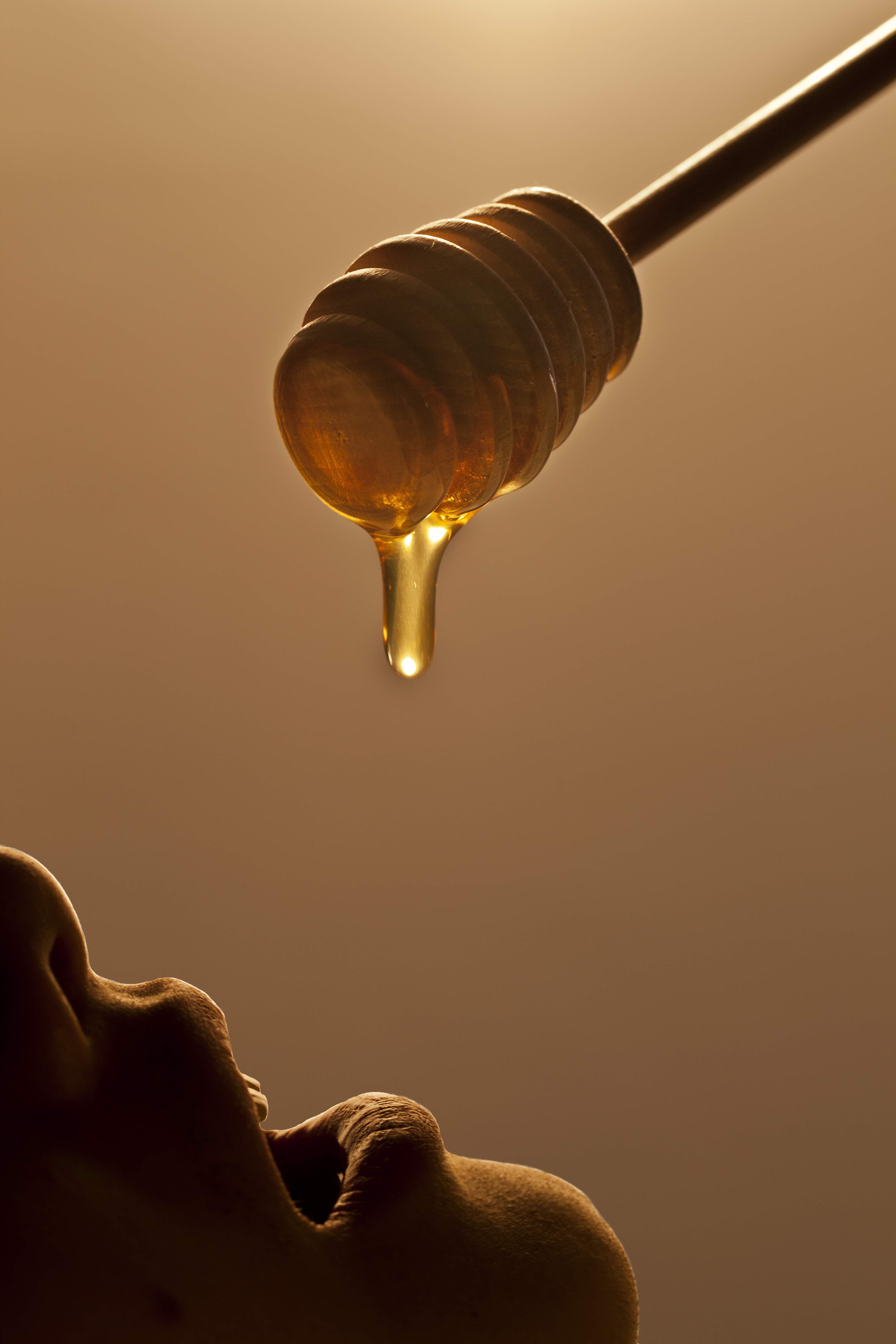
In the next assignment at Seattle Central Creative Academy, I had to create a product shot using only one tungsten source light.  With a white screen as backdrop and Desisti directly behind and overhead, I used a couple C-stands and arms to hold a wooden honey stick in place.  To camera right was a golden reflector.  To camera left a silver reflective cloth.  And overhead I covered myself and the honey stick in another screen clothe to create a tent.  Once the focus and lighting was perfected, I dipped the stick into a jar of honey and began snapping.  After roughly 1000 frames, with different focal planes and lighting arrangements, I stuck with this one.  Next, I brought in a friend to sit underneath the honey stick to pretend to catch the dripping honey.  The final image was a composite of the two created in Photoshop CS5.

Reflections: Next time I would have used more reflectors to bounce the golden light back to the honey, and I would have used a female model with red lipstick, instead the male model who was available.  Also, upon further reflection, the proportions are off with the lips too small against the large honey stick.  Otherwise, I enjoy the honeycomb lighting and the effect the shot creates.

Location: SCCA Studio, Seattle, WA

Camera/Lens Specifics: Canon 5D Mark II with Canon EF 100mm f/2.8 L Macro IS USM

100mm, 1/8 sec at f/8, ISO 100, tripod mount, trigger fired.

Post: Adobe LR3 & Photoshop CS5

Seattle Central Creative Academy: Photography Assignment (Aperture)

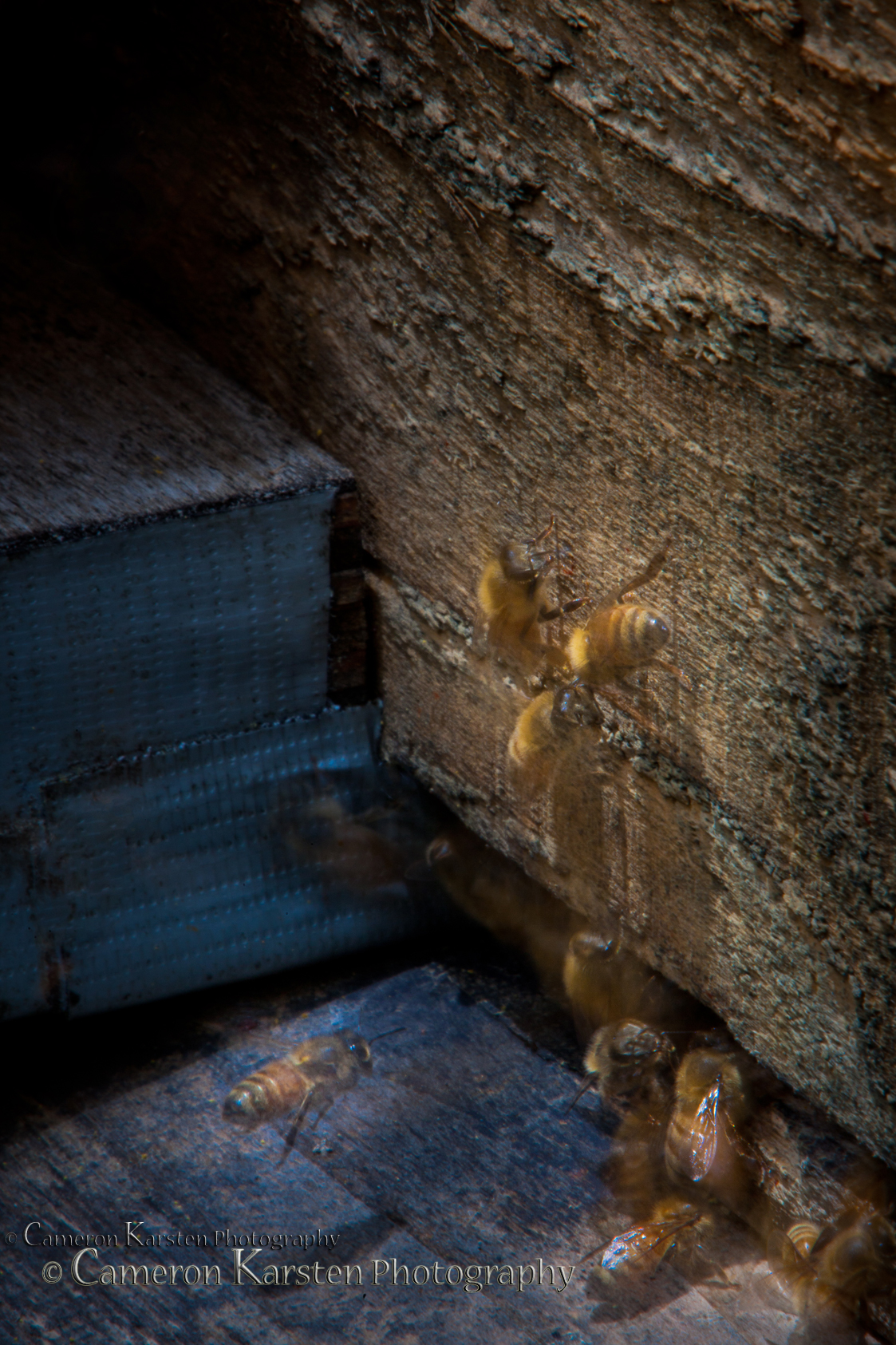
I’ve always enjoyed observing and learning about bees, and with this next assignment to show the opposites of aperture, one frame wide open with a shallow depth of field and the other as deep as it would be deemed fitting.  Thus, with a 70-200mm lens and an attached doubler, I set my 5D Mark II on a Manfrotto tripod and started shooting.  The first one was as shallow as possible, isolating the entrance to the hive and stopping the bees in motion.

Location: Bainbridge Island, WA

Camera/Lens Specifics: Canon 5D Mark II with Canon EF 70-200mm f/2.8L USM, attached Canon EF 2.0X III Telephoto Extender

400mm, 1/80 sec at f/5.6, ISO 1000, tripod mount, trigger fired.

Post: Adobe LR3 & Photoshop CS5

To create depth of field I closed the aperture to f/64 and set a Canon Speedlite 580EX II flash with a Gary Fong LightSphere Collapsible Diffuser onto the bee hive.  With each pop, the bees were froze in motion, however the extended shutter speed capture more ambient light in the frame and began turning the bees into ghostly apparitions.

Location: Bainbridge Island, WA

Camera/Lens Specifics: Canon 5D Mark II with Canon EF 70-200mm f/2.8L USM, attached Canon EF 2.0X III Telephoto Extender

400mm, 1 sec at f/64, ISO 200, tripod mount, trigger fired.

Post: Adobe LR3 & Photoshop CS5

Seattle Central Creative Academy: Photography Assignment (Shutter Speeds)

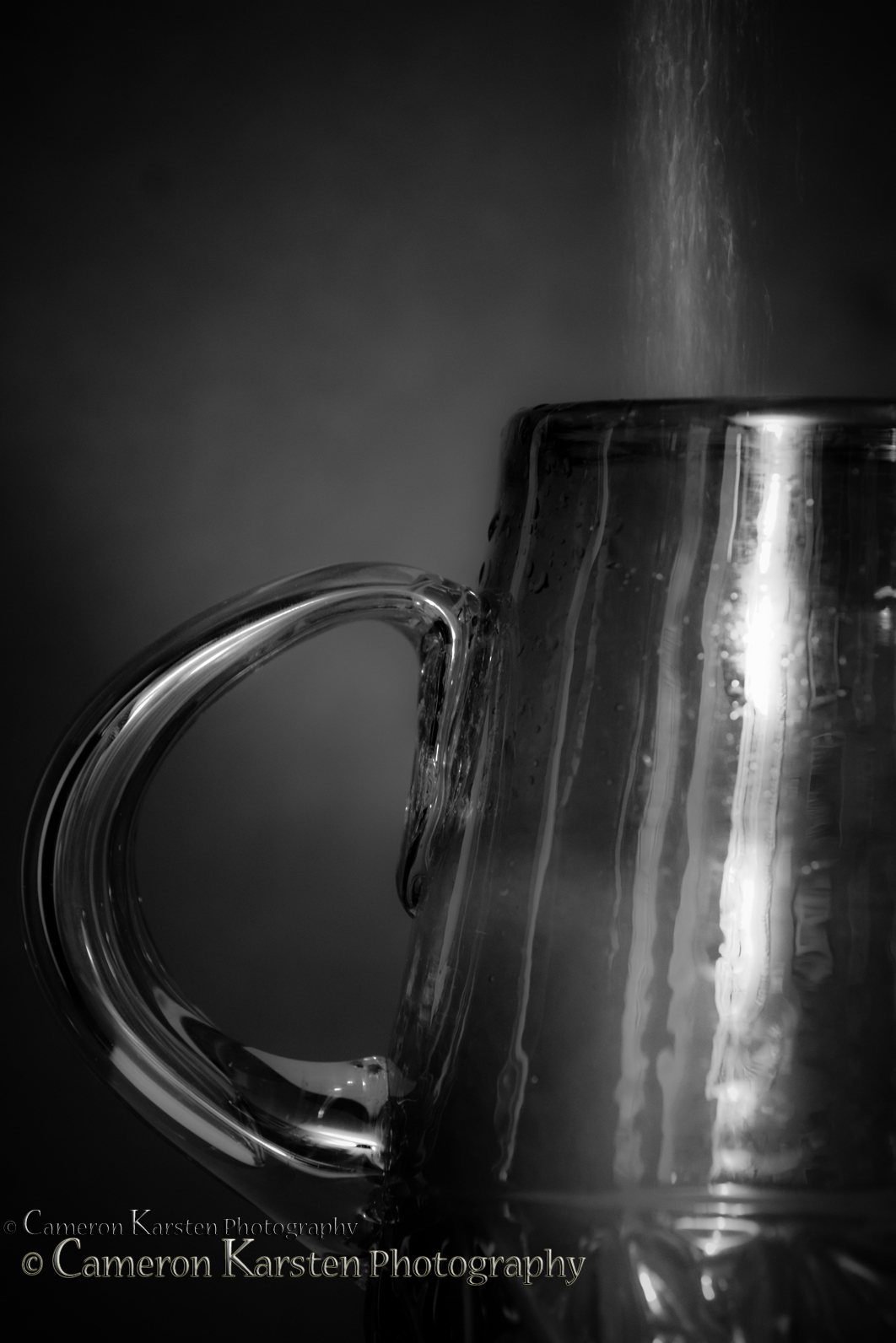
To freeze and create motion involve one key element: light.  With enough light you can freeze your image and make time stand still.  With way too much light, your object in motion will become a white backdrop.  And within a studio you have all options available to use one subject in order to freeze it’s substance as well as allow motion to move in the subject.  I experimented with a blue water vase from Anthropologie and the action of pouring water.  For the above shot, the process was simple: dark studio, two Q-Flashes, camera on tripod, shutter release trigger and the correct adjustments.

Location: Home Studio, Bainbridge Island, WA

Camera/Lens Specifics: Canon 5D Mark II with Canon EF 24-105mm f/4 L IS USM

165mm, 1 sec at f/5.6, ISO 1000, tripod mount.

Post: Adobe LR3 & Photoshop CS5

The next shot was more complex because I discovered that by slowing the shutter speed to capture the motion of the water into the container, and simultaneously popping the flash, I only captured the instant when to flashes fired.  And when the flashes were off, and the shutter speed adjusted even longer, the clarity of the water never appeared in the final frame, only the jug against the black background.  So, by changed liquids, substituting coconut milk for water, and turning off all lights once the jug was in focus in camera, I started pouring in the coconut milk before triggering the shutter speed for 2 secs and viola.

Location: Home Studio, Bainbridge Island, WA

Camera/Lens Specifics: Canon 5D Mark II with Canon EF 24-105mm f/4 L IS USM

210mm, 2 sec at f/5.6, ISO 1000, tripod mount.

Post: Adobe LR3 & Photoshop CS5

Seattle Central Creative Academy: dSLR Portrait Assignment (Natural Light)

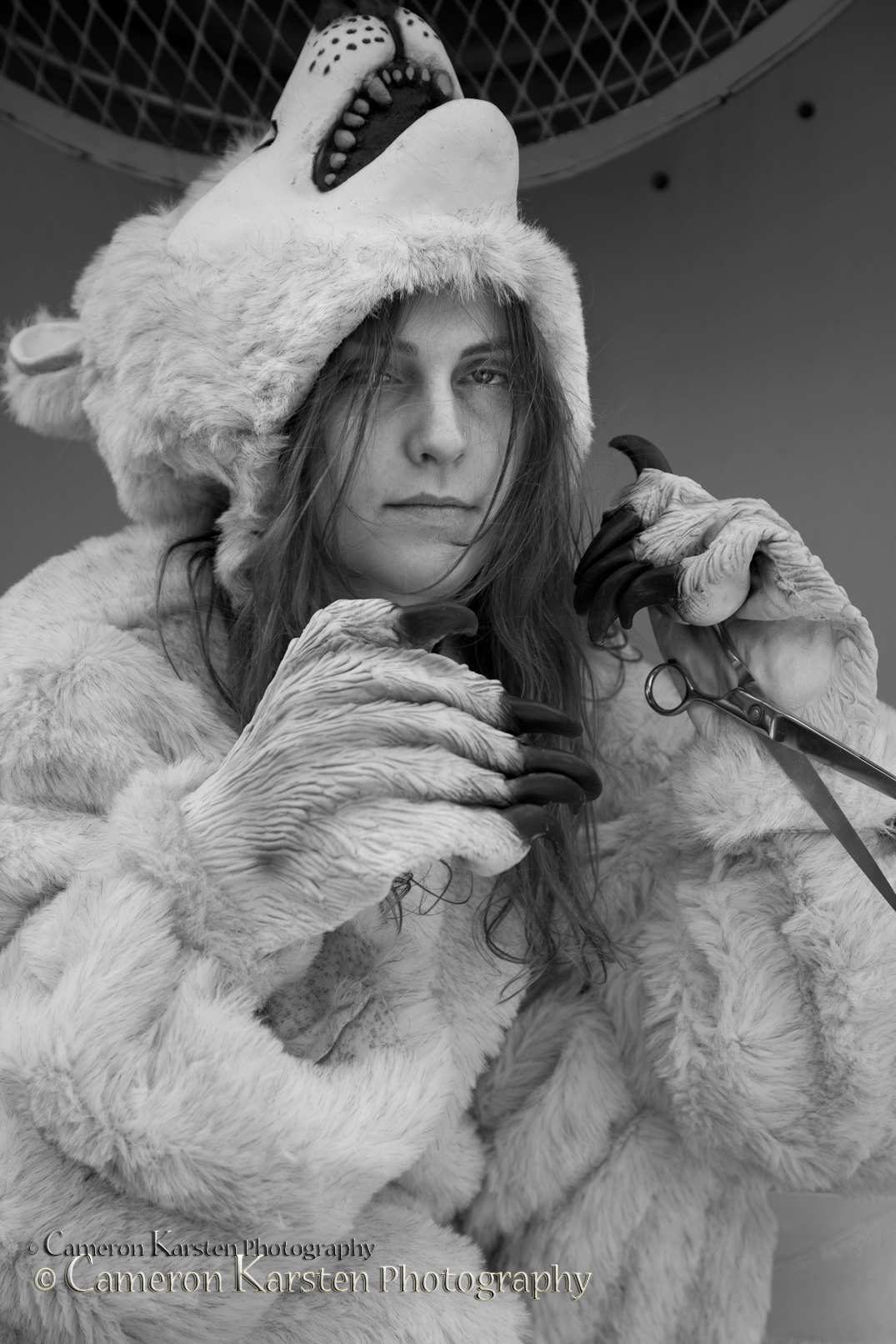
The goal was to create a portrait using existing light.  Reflectors yes.  Strobes or flash no.  To make it interesting I handed a polar bear costume to model and fellow student Jessica Yager.  Then for further eccentricities, I handed her metal shears.  Thus, upon a roof in Pioneer Square under cloudy skies with the use of one reflector, the portrait transformed into a crackhead on the loose in the city.

Location: Pioneer Square, Seattle, WA

Camera/Lens Specifics: Canon 5D Mark II with Canon EF 24-105mm f/4 L IS USM

88mm, 1/125 sec at f/5.0, ISO 100, tripod mount.

Post: Adobe LR3 & Photoshop CS5

Seattle Central Creative Academy: Photography Assignment (Existing Light)

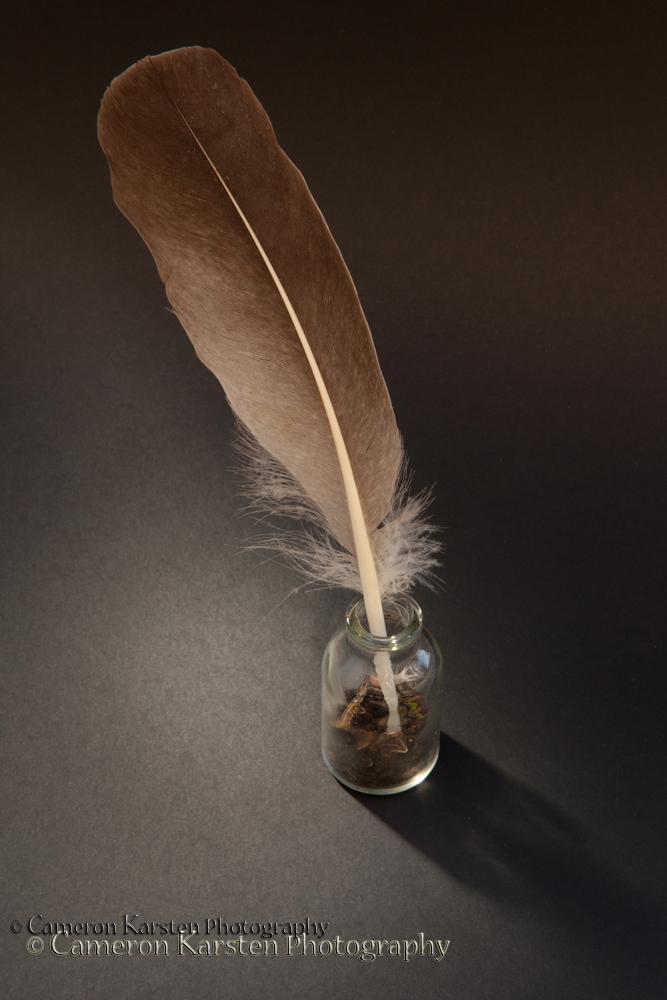
As part of our first assignment in Seattle Central’s 1st yr Commercial Photography program, students were asked to photograph an object using existing light; meaning no false lighting, only the sun, a reflective surface, and our innovation.  I chose a feather resting in a small glass jar to represent a writer’s quill photographed as a still-life.  The above image was created using a sheet of black construction paper as a seamless, with the sun at camera right and a reflector placed 90 degrees on camera left.

Location: Cal Anderson Park, Seattle, WA

Camera/Lens Specifics: Canon 5D Mark II with Canon EF 24-105mm f/4 L IS USM

105mm, 1/60 sec at f/22, ISO 800, tripod mount.

Post: Adobe LR3 & Photoshop CS5